Showing posts with label Zimbabwe. Show all posts

Sunday, August 12

peak oil hits third world

Kim and I witnessed this in Zimbabwe last year, but didn't realise how pervasive it was until we read this...

By Chris Nelder

I've been watching and waiting for these signs for about five years now: Not just high prices and declining exports, but the slowing of commerce, interstate trucking and air travel, food shortages and similar indications.

But the actual feeling of peak oil didn't really hit me until this week, as I perused a page on Jim Kingsdale's excellent Energy Investment Strategies site, listing countries that are currently experiencing serious fuel shortages and grid blackouts.

Here in the first world, we still have the luxury of armchair theorizing about peak oil, and paying a bit more for gasoline, but the third world is actually feeling the pain of peak oil today. Rising oil prices are acting as a regressive worldwide tax, pricing poorer countries right out of the market.

Since their experience must to some extent herald ours as peak sets in, let's see how peak oil feels to those who are undergoing it firsthand.

Asia and Middle East

Nepal: Gasoline and diesel shortages are crippling the country. In July, the Kathmandu valley was hit with its worst energy crisis in history as the state-owned petroleum importer and distributor stopped supplies to gas stations entirely. Fuming taxi drivers subsequently parked their cars before the heart of the Nepalese government center to protest the shortfall. The Nepal Oil Company (NOC) has been facing cuts from its sole supplier, the Indian Oil Corporation (IOC), because of mounting debts owing to Nepal's subsidies, which force NOC to sell fuel below cost.

Pakistan: Chronic power shortages have led to riots in the streets in Karachi. At one point this summer, the gap between supply and demand reached a peak of 3,000 megawatts (MW). Due to chronic underinvestment in energy infrastructure, the country's Planning Commission estimates that its shortfall in oil supply will grow to 3.2 million tons of oil equivalent (TOE) in 2010, and 21.5 TOE in 2020.

Iraq: Iraq has suffered from an acute shortage of oil products since the U.S.-led invasion in 2003. This week brought a report that Iraq's electricity grid could collapse any day now, due to sabotage, rising demand, fuel shortages, and provincial officials who are disconnecting their local power stations from the national grid (presumably in the interest of self-preservation). Constant attacks on pipelines have made it impossible for Iraq to meet its internal need for gasoline, forcing it to rely on imports to the tune of 1.3 million gallons per day. At the same time, it is being forced to reduce subsidies on gasoline in order to meet IMF debt-reduction requirements, even as it struggles with 60% unemployment and rampant poverty as well as chronic grid blackouts. Oil smuggling and a robust black market have sprung up to take advantage of an estimated 10x spread between the official subsidized prices and black market rates.

Iran: Chronic gasoline shortages have forced the government to impose rationing. Motorists can buy only 100 liters a month at the subsidized price of 1,000 riyals (about 11 cents) a liter (the cheapest gasoline in the world). Iran's program of oil subsidies--combined with sanctions from the West over its nuclear intentions--has proved disastrous, putting the government in an intense budgetary squeeze. Angry protesters torched 19 gas stations in response to the rationing in late June. Tehran currently imports about half of its gasoline, and absorbs a loss of nearly $2 per gallon on it, creating an intense drain on the national coffers. As in Iraq, rationing is expected to lead to a brisk black market.

Bangladesh: The shortage of electricity is acute, to the tune of about 2,000 MW a day, which is resulting in regular blackouts. Bangladesh's attempts to import electricity from India, Nepal and Bhutan have been fruitless, so in June the country obtained permission from the International Atomic Energy Agency (IAEA) to begin building nuclear power plants.

Sri Lanka: Severe shortages of fuel have led the UN to warn the government that it may not be able to continue providing humanitarian aid or preserve its supply of vaccines and essential medicines. The UN agencies have been forced to curtail the usage of generators and vehicles. Construction activity in the Jaffna and Wanni regions has all but ceased due to the lack of fuel.

Philippines: A deadly tropical storm hit the country this week, bringing an end to a three-month drought that had severely reduced the country's electricity output. Extremely low water levels were recorded at five major hydroelectric power dams, one of which was forced to shut down entirely. The shortage caused sporadic electricity outages in the country's capital of Manila, which turned to coal and oil-fired power plants to make up the difference.

China: A red-hot economy with rapidly growing industrial sectors has put China in a constant state of electricity shortages, with brownouts a common occurrence. Shortages of coal, power and oil have been reported. Top refiner Sinopec has stopped selling refined products to other companies and private filling stations in order to maintain supply to its own outlets, and some oil dealers are suspected of hoarding supplies. Now the world's second largest energy consumer (behind the U.S.), China's total energy consumption has risen by an average of more than 11% each year for the last five years, 70% to 80% of which is supplied by coal. Meanwhile, all of that coal is casting a shadow of soot around the world, dropping it in places like the west coast of the U.S., and causing acid rain that poisons lakes, rivers, forests and crops. It has been estimated that fully 77% of the black carbon emitted into North America's lower atmosphere comes from Asia.

India: Soaring temperatures as high as 122° F have caused hundreds of deaths and raised grid demand to a record 4,000 MW in the capital of New Delhi, where rolling blackouts and equipment failures have caused power outages lasting up to 15 hours a day. Chronic power shortages in urban and rural India are crippling industrial and agricultural productivity and discouraging foreign investment. The country is currently looking to nuclear energy to provide some relief.

Vietnam: Another red-hot Asian economy with electricity consumption growing at the rate of 15% to 20% annually, Vietnam is facing a 1,000 megawatt shortfall in peak power production. The capitol has ordered local governments to keep the thermostats set no lower than 77° F and to turn off air conditioners a half-hour before the end of the day--with a $1,250 fine for non-compliance.

Africa

Some 25 of the 44 sub-Saharan nations are facing "unprecedented" and crippling electricity shortages with common power outages, even in South Africa. In Nigeria, Kenya, Tanzania, Uganda, Ghana and other parts of West Africa, drought has slashed the generating capacity of hydroelectric dams, which is in turn crippling production of gold, aluminum, and other basic metals.

Uganda: Electricity shortages are frequent as the grid is strained beyond capacity, largely because drought has lowered the water level of the Nile River, reducing hydroelectric generation. Parts of the capital are blacked out for as much as a day at a time. The country has leased two 50-megawatt diesel-burning generators to compensate, reportedly costing the nation about as much as it would have cost to build two new hydroelectric dams. And in a horribly ironic twist, grid power shortages are shutting down a pipeline from Kenya, adding to the diesel shortages.

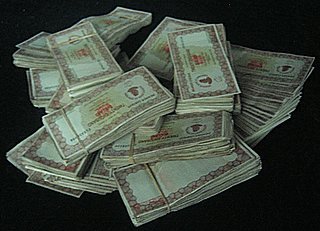
Zimbabwe: Critical gasoline and diesel shortages are ruining the economy, pushing the price of a liter of petrol to a staggering 120,000 Zimbabwe dollars. Fuel stations went completely dry in June, and there have been long queues at the few which had any to sell.

Ghana: Electricity shortages are causing load shedding blackouts, costing the economy on the order of US $5 million a day. Ghana, among others, has compensated by leasing huge gas generators to produce emergency power--at exorbitant rates.

Nigeria: An acute shortage of fuel occurred in June due to strikes by unionized oil labor over wages, a hike in fuel prices, and the sale of two refineries. Nigeria Labour Congress (NLC) has vowed to cripple the government of Oyo State if it makes good on its threat to eliminate some of the state work force. Abductions, killings and robberies have plunged the oil-producing parts of the country into chaos. Only 19 of 79 power plants even work, and blackouts are costing the economy $1 billion a year. In Nigeria, Angola and other nations, most businesses and many residents run private generators because the grid is so unreliable, adding to their economic and air pollution woes. Imagine: "I've been on the 20th floor of an apartment building in Luanda, and there would be generators on all the verandas, with the racket, the fumes."

Senegal: State power company Senelec has been unable to pay for supplies of fuel for its oil-fired power stations, leading to cuts in electricity supply. China has come to its rescue with a 370 million yuan loan to fund a new distribution network, in addition to its commitment to build a 250 megawatt coal-fired power station there.

Kenya: Gasoline and diesel shortages in Nairobi are grounding industrial and personal transport alike, and price hikes appear likely.

Gambia: Shortages of gasoline and diesel are taking an economic toll across the country, with many empty petrol stations and long lines at stations that have fuel to sell--but only to customers holding coupons from Shell.

Americas

Argentina: The country is facing its worst energy shortage in nearly 20 years. An increase in heating demand caused by an unseasonably early cold snap, combined with the failure of a power plant, caused the collapse of both the power grid and the fuel supply system. Electricity supplies have been severely curtailed, plunging entire districts into darkness and causing the layoff of industrial workers. Shortages of compressed natural gas, which powers many Argentine cars and 90% of the capital's taxis, are common. Argentina now has less than ten years' worth of gas reserves, and can no longer meet peak electricity demand.

Nicaragua: Electricity shortages have led to widespread blackouts, prompting the recently re-elected president Daniel Ortega to promise an end to the "energy bankruptcy" that has afflicted the country. The nation's energy deficit is running between 20% and 30%, forcing the power-distribution company Unión Fenosa to shut down whole cities for six to ten hours at a time. Ortega announced that nations such as Iran would help to build new energy plants to address the issue.

Chile: Reduced supplies of natural gas and lower-than-average rainfall have pushed electricity spot prices to record highs, prompting concerns of inflation and reduced valuations of the country's energy companies. The market took Chile's third-biggest power generator, Colbun SA (COLBUN CC), to the woodshed in early July.

Costa Rica: Beginning in April, Costa Rica began experiencing nationwide electricity blackouts, forcing emergency rationing. The country's hydroelectric capacity is strained to the max, due to a dry summer cutting power output by 25%, damaged turbines at oil-burning thermal plants, and Panama's decision to stop exporting electricity to Costa Rica. Blackouts are now routinely scheduled.

Dominican Republic: Electricity blackouts have become commonplace, apparently due to a lack of fuel and regular maintenance of power plants. Programmed blackouts have now spread from the barrio neighborhoods to the exclusive residential districts.

The picture is clear: the poor and undeveloped countries of the world are the first to fall before the remorseless price inflation brought by peak oil.

Claude Mandil, the head of the International Energy Agency, warned recently of a "catastrophe" for the world's poorest countries as they are forced into the suicidal practice of subsidizing oil just to keep their economies running.

Since we know that there is little point in trying to radically increase anyone's supply of oil, gas or coal at this point, there are only two paths left to choose: powering down or going renewable.

You know what our preference is. Who can turn his back on industries that are growing at the rate of 25%+ a year? While aging oil companies struggle to suck "the last days of ancient sunlight" from the ground, warily eyeing their incipient declines, there are young, agile companies eyeing the abundant and untapped solar, wind, geothermal and wave potential in most of the above countries--with the eager support of the World Bank and the IMF.

Oh, and us profit-seekers over here at Green Chip Stocks.

Until next time,
Chris

Friday, April 14

next

I stumbled across these words in an old notebook yesterday.

They had spilled out back in December, while working on my Yurt...


By now it must be obvious, to most thinking people, that we are at a crossroads. Despite the promises of a clever scientific and technological solution some time in the future, what we are seeing today, are little actuality that is leading us to such a future, and plenty of examples of a path of incredible destruction and suffering in so many forms it is hard not to weep. We need to decide if we are going to remain committed to the technological path, pursuing the status quo in our hybrid cars and solar powered homes, or choose a direction that will make the planet's essential and life-giving resources more equitably available to more of the planets population.

After so many years of acknowledging that Nuclear active materials are not neutral in their effect, and in fact having already witnessed the unimaginable human suffering it has caused - we still stood mostly silent as several hundred tonnes of it were dumped on the people living in that part of the planet we label the Middle East. While in Zimbabwe I saw a shirt that said "Labels are for jars." The Middle East is not a separate place, occupied by aliens. The "Middle East" is a place, like New Zealand, filled with people like you and me. With mothers, fathers, daughters, sons, brothers, sisters, friends and loved ones.


You and I are witnessing a rush of depletion of our life-giving soils, our fresh water, diversity of food sources, and social and cultural diversity, and we, the people that are the fabric of our society, are vulnerable and at risk.
Mere contemplation of the extent of the devastation of those diverse elements which combine to make for a healthy society - a society made up of happy, creative, loving, caring, crazy, humorous, wise, visionary people - gives me chills. It is occurring at an extraordinary rate.

How can the small me, just one in millions, make a difference?

Yet I know now (based on study and intuition based on observation) that I must, I know that I am part of the solution and part of the problem.

I have kick started a weekly documentary film night at the local community cinema, where valuable information is shared with those curious types who want to know what is happening in their world. I have catalogued and made some of this information available on a computer hard drive.

I have started riding a bike. I still share a car, but I sold my heavy tin box seven months ago.

I have a small garden established. It gave us most of our salad needs through summer, and continues to do so. I am working on expanding it to increase our reliance, and to reduce our dependence on Woolworths.

I have started a community garden, and a Saturday market food exchange stall. I am helping a bright young horticulturalist who has begun a local service of offering to help people who want to start their own garden. And I would be happy to help anyone who wants to participate in starting up a local complimentary currency to manage some of our local exchanges.

I am now starting to offer, among my community here on Waiheke Island, help with facilitating dialogue, using the wonderful Mapping Dialogue document that was created by the founders of Pioneers of Change.


This document was one of many gifts received from the Learning Journey at Kufunda. But it was defenitely the most significant. A couple of years ago I got involved in a community effort to help a group of parents have some influence on the design of an about-to-be-built new Primary School on Waiheke Island. Our struggle to engage in dialogue with the parties who were making the decisions extended over a period of several months, during which time I have never worked so hard and felt so ineffective.

Since then I had a burning question. How is it possible to bring together people with disparate points of view and have them engage in effective dialogue, where everyone is heard and decisions are made together on the basis of mutual understanding?

Using these tools I am offering my time to help facilitate dialogue for groups and individuals who serve in such valuable-to-our-society functions as teaching our children, ensuring fair access to resources such as housing, food, and water, or simply cooperating to share the fruits of their labour with each other at a weekly market.

The size of the problem seems so vast when we are working alone. Yet, happily I am finding there are more and more people who are picking up the baton and running their leg of the race. The race to...

...to what?

What do we want Yesterday's Future to look like - tomorrow?


Mapping Dialogue


This document was for me, the major gift of a two week visit to the Kufunda Learning Village in Zimbabwe. You can download the document from here


"An answer is always the part of the road that is behind you. Only questions point to the future." - Jostein Gaarder


Here's an excerpt from the Introduction:

The modern world loves answers. We like to solve problems quickly. We like to know what to do. We don't want to "reinvent the wheel". We don't want to "waste our time". And when we have the answers or have a wheel invented we like to pass on the information to others. We do this through the media, through training programmes where teachers pass on answers to students, or through conferences where experts speak on panels while hundreds listen (or pretend to listen) in the audience. This approach may be useful for some situations, but is problematic for a number of reasons, particularly when working on social and human challenges in the 21st century.

Firstly, we live in a world of increasing complexity, where answers have a short life-span. Adam Kahane in his recent book "Solving Tough Problems" (2004) points out that tough problems are characterised by three types of complexity. Dynamic complexity means that cause and effect are distant in space and time. To address this type of complexity you need a systemic approach to the problem and the solution. Social complexity means that there are many different and usually conflicting points of view and assumptions about the issue, and the problem isn't owned by a single entity. This demands a participative approach. Finally, generative complexity means that the old solutions are no longer working, and the problem is constantly changing and unpredictable, which requires a creative approach. Not all problems are dynamically, socially, and generatively complex, but most if not all of the major social issues South Africa as a country is currently trying to work through are. Hiv/AIDS, black economic empowerment, democratic transition, globalisation, unemployment, and crime are all perfect examples.

Secondly, it seems to us that people have an inherent desire to want to solve their own problems. When universal, formulaic responses are imported or imposed from the outside, they meet resistance and often fail. This is partly because they are not exactly appropriate in the given context, but just as much because there is a lack of ownership from people who haven't participated or been consulted in the decision-making. Human beings have a living, deep impetus for freedom and self-determination, and given appropriate circumstances, people are usually more resourceful than expected in terms of finding their own answers.

They buy in to, and own, solutions they have been a part of creating. The success of implementing interventions on social issues often depends more on ownership and motivation of those involved than on the cleverness of the idea.

Even if only for these two reasons, we need to be adept at asking questions, and at talking and listening to each other. These are age-old competencies. For millennia, people in villages across Africa have worked through collective challenges, creating solutions through conversation. But it is not only when the group is faced with problems that dialogue comes in. Life in an African community is an ongoing conversation.

Why is this art of talking declining? Many of us seem to have forgotten how to engage in, and be present to, such conversations. In these times of busy-ness, information overload, electronic communications, scientific rationality, and organisational complexity, we are forgetting how to talk to each other. Fortunately, as a response to this trend, a number of methods for facilitating dialogue have been emerging globally, in particular over the past 20 years.

This collection profiles 10 such methods in depth and a number of others more briefly. The approaches are diverse in many ways. Some are designed for small groups of 20 people, some can accommodate up to 1200 or even 5000 in dialogue at the same time. Some focus on exploring and resolving conflict and differences, while others emphasise looking first to what is working and agreed upon. Some are explicitly dialogues between groups while others require each participant to be there only as themselves and individuals.

Yet across all these dialogue methods are some clear common patterns. They focus on enabling open communication, honest speaking, and genuine listening. They allow people to take responsibility for their own learning and ideas. They create a safe space or container for people to surface their assumptions, to question their previous judgments and worldviews, and to change the way they think. They generate new ideas or solutions that are beyond what anyone had thought of before. They create a different level of understanding of people and problems. They allow for more contextual and holistic ways of seeing. They lead to "a-ha" experiences.

Each of the profiled approaches has a life story behind it. Many of these stories begin with a person who posed a question. "How do the questions we ask shape our reality?" "Given that the coffee breaks seem to be the most useful part of the conference anyway, what if the whole conference was designed similar to a coffee break?" "What is being lost when we just take majority decisions and don't hear what the minority has to say?" "How do we create a networked conversation, modeled on how people naturally communicate?" "Why are we recreating the same conference rituals when they are passifying us and limiting our creativity?" "Why are we not managing to bring in the collective intelligence of hundreds of people but rather choosing over and over to just listen to a few expert voices?"

These inquisitive characters proceeded to experiment with new ways of organising conversations. They drew inspiration from indigenous cultures, lively cafés, international peace processes, and personal experiences of trial and error. The result is the potpourri of possibilities described in the following pages.

You can download the document from here

Tuesday, April 11

money - part 1

I believe that every event, every meeting, every moment of life is an opportunity to learn. Even though first impressions of people, situations and events may lead one to assume that this is otherwise, a small gesture of openness is often all that is required. I confess that on arrival at the slightly run down DOC camp in the back blocks of Taranaki, I had to tell myself "there is something to learn here" and with that throw myself into conversations - that I am happy to report revealed a circle of dedicated people who had lots to teach me.

The LETS movement in New Zealand has had its moments of growth and decline - often in synch with the relative buoyancy of the market economy in which we find ourselves functioning. When people are "down on their luck" they will often turn to the complimentary currencies and find them to be a useful means of managing exchanges of goods and services which they might otherwise not be able to access, due to a lack of cash. Unfortunately if people are not educated in the realities of the market economy and how that economy undermines the social and environmental capital of their community, they will often turn their back on this tool when the market becomes buoyant again.

But the people at this annual LETS conference are the troopers. These are the ones who are working to maintain and constantly improve the functioning of the complimentary currencies that we New Zealanders can plug into and take advantage of. They are always available to welcome new members and educate them into the benefits of using a currency which does not support the upward flow of wealth from the broad lower levels of society to the small numbers of ever more wealthy elite.

I wish this subject were easier to write about. But it's not. And part of the problem is the incredible level of mis-information which we have been bombarded with, since birth. The serious study of money is something few of us dare to tackle. It has been made to appear so complicated, and beyond our comprehension. Better that we just get up each day and go off to work, to earn enough of the stuff to pay for the food, clothes, shelter and other needs which seem to cost us more and more each day. We don't really have the time to delve into this, even if we imagined that a) we could come to some significant degree of understanding of the subject, or b) have any influence on changing it if we found it to be lacking in any way.

I will write more on this subject soon (as soon as I can figure out how to simplify this subject for you). In the meantime I will leave you with these questions to prompt your thinking - till we meet again:
  • Who prints the money that we use?
  • How do they decide how much to print?
  • Why does the value of our money constantly reduce (or costs rise)?

Thursday, April 6

complimentary currency

One of the gestures being made by the Kufunda Community in Zimbabwe is to print its own money. This is an obvious move in response to an inflation rate in that country that is running at over 700% (at the last report). This is a practical step in creating a means to organise exchange between people in the wider community, by using a measure that holds its value because it is tied to something real and something everyone can relate to.


This weekend we are off to Taranaki to attend the New Zealand LETS conference, where I hope we will learn of the growing uptake of different examples of complimentary currencies across the country. I hope there will be lots to report on our return from this journey.

I have long felt that the existence of a stable means of measuring exchange are a foundation stone of any society. And I think complimentary currencies
such as this will become invaluable when the impacts of our present political, social and environmental direction result in a significant breakdown of the present economic structures we have come to rely upon, and which we foolishly(?) assume will always exist, pretty much in their present form.

And if I am wrong about the likely demise, then there are other good reasons to seriously think about taking up such alternative systems. One of these is to reclaim control of the mechanism of exchange we consent to use. At present the exchange is controlled by a few greedy bankers, and the system advantages them very well but does not work so well for the good of the whole - the planet or its people. Our current economic model is a not insignificant factor in the manifestations we see around us - this is yesterday's future, what do we want tomorrow's future to look like?

Thursday, March 30

home for two weeks

We have been home from Kufunda for 15 days now.


The dichotomy of living in a culture that has so much material wealth and displays such little respect for life - earth, air, fire and water versus having just experienced a culture that has minimal material wealth but a spirit for celebrating what they do have - is working on me.

Sitting here on a cliff overlooking a huge and beautiful, ever-changing ocean vista I go back to Zimbabwe for a while...

Visiting the small village of Zcimba, in the Mugabe home district, was full of so many emotions, shocks and joys.

We arrived as the sun was setting under a blanket of grey cloud, but the welcome was like sunshine lighting up the whole village. Their flag of welcome to the Kufunda village that said everything about how much they appreciated the help they had been given by the Kufundees. But they expressed it with their whole bodies. The high pitched lelelelelelelelele from the woman as they sang, danced, embraced us all, and opened their homes and hearts to us. I felt so happy to be there, yet somehow
inadequate in my response.

The evening began with a circle gathering in the pre-school building, which had big dollops of the absurdities of some of our western help. After some food we gathered again to pass the talking piece and share a little about who we were. The Zcimba community organisers spoke near the end and made reference to some of the work they had done and achievements since the Kufundee's last visit.
They had helped their local community to build 123 compost toilets over the 2005 year, and this was a celebration.


A moment of silence followed, after everyone had spoken. Then a voice! A song had begun and others joined, then the women - the community organisers were up.

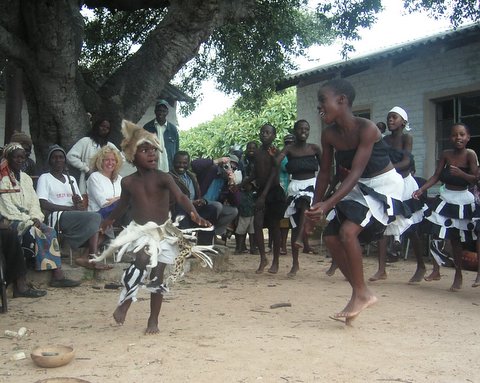
Picture these strong, passionate, energetic woman of every age (though the elders seem to have the biggest numbers). They are dancing like the heavens had opened and showered them with every imaginable gift - their gratitude was palpable. And their lyrics told of the strength of these spirited women.


We had been shown our rooms, and as the dancing and singing came to a natural end we wandered back to our places of rest - beds which had been surrendered for the night, a hammock tent for the hardy, or the back of the van for some others.


As we came together for breakfast I felt some humility, at realising how much I have in terms of the access to good food, a comfortable bed, a shelter that doesn't leak, electricity to run my computer and give me light, ease of travel, and so on and on. I was very grateful for the porridge they went out of their way to bring us - as an alternative to the hard Maize meal, that is their staple.

Then we were shown around some of the neighboring villages, to see and celebrate their composting toilets. These toilets seemed such a sign to me, that unlike us in the west with our fecal fear, and deep reluctance to take care of our own ----, they are making the re-connections between human beings and nature.

They are working with and responding to the obvious link between soil and food. I sense they are seeing that we have to participate in and preserve nature, and not be only on the take, if we are to feed ourselves. We must become an active part of the cycle.


Back at the school grounds, it soon became clear, there was a party going on! It began slowly and sustained for a long time, before the kids came on and gave us a show of energy and happiness that left us all smiling till it hurt.

I feel part of a culture in which like many others, I am so often, so self-concerned. I wonder. Where this ability comes from? The ability to live on the edge, not knowing if, a failure of their health (and inability to get help), their neighbours stealing their food, their elected representatives, a failure of the crops, the weather, or the next financial crunch, is going to bring them more hardship. And in the midst of this to be able to dance and sing and express love and gratitude. Where does this come from?


Saturday, March 25

Open Space Technology

It has only been a few days since we arrived and already I feel deep gratitude for the people and their heart. The invitation to participate in an Open Space technology event one day, was a welcome chance to offer something , anything, back to the Kufunda community.

Open Space Technology was created in the mid-1980s by organizational consultant Harrison Owen when he discovered that people attending his conferences loved the coffee breaks better than the formal presentations and plenary sessions.

Combining that insight with his experience of life in an African village, Owen created a totally new form of conferencing.
Open Space conferences have no keynote speakers, no pre-announced schedules of workshops, no panel discussions, no organizational booths. Instead, sitting in a large circle, participants learn in the first hour how they are going to create their own conference. Almost before they realize it, they become each other's teachers and leaders.

There are some simple rules to this process and Kim and I both enjoyed being on the side of giving from our knowledge, to this community which is so open to listening and considering new ideas to see if they may be applicable and helpful.


Kim spoke with some women about different approaches to early childhood education, and I demonstrated a method of low energy cooking.

A common site was women carrying big loads of firewood on their heads - wood is the only cooking fuel for a lot of communities, and deforestation is a real issue. The Kufunda community is playing their part by helping others communities build efficient fireplaces (using material from old termite mounds).


My offering was to show how it is not necessary to keep a pot boiling in order to cook food, but if it is brought to the boil then kept highly insulated, it will continue to cook - just more slowly. So we put some rice in some cold water, brought it to the boil and put it in a large carboard box stuffed with straw, so that the pot was surrounded on all sides. 30 minutes later it was cooked. This fuel saving method was well received and because it was demonstrated, will probably be embraced.

While our experience of Open Space (one of the simplest, most brilliant combinations of order and chaos, which is most powerful when conducted over two or three days) was very brief, it offered a delicious taste of what it could be.

Saturday, March 18

calling a circle

On the afternoon of the first day, Marianne and several of the other Kufundees invited us into a Circle. This was the first indication that this community was being built with processes that were simple, real and practical.

We were introduced to the idea that learning can be exchanged between everyone. When we open ourselves to receive from others and when we assume we have something to give no matter what we assume is our 'position' in society, our experience, knowledge, qualifications, or how much paper (money or property titles) anyone holds.


That evening we went to Harare for a night of comedy in the Book Cafe. Happily these brave people were able to bring their much needed humour to address the political madness that surrounds them.

The next day we had a trip to Highfield, a ghetto in Zimbabwe's capital of Harare. This was, in Chris' words, "where we met some righteous youths fighting to make a difference in their community with permaculture, art and wisdom as their weapons."

We were invited into their humble house where the Highfield activists called a circle and introduced us to the various collectives that made up their group and what each one was engaged in.

The Arts Collective included activities such as the Theatre of the Oppressed (I hope to get some video material from them). The Media Collective who were printing and communicating their own news. The Permaculture Collective who were networking and involved in health issues and growing food. And The Labour Collective who supported Labour Unions and other Civil Organisations. Kim said it was how she imagined a visit to a Black Panther meeting in the US might have been back in the days when they were a force for
positive change in their community in the US.

It was during and after this visit that I periodically experienced a persistent flow of moisture from my eyes and become aware of a cramp in my chest, which I was able to relax through to some extent. It was an experience that continued throughout the 12 days we were with these Kufundees and all the other spirited people they introduced us to.


These are mostly young people who know that the future is in their hands. Maybe the fact that Kim and I are expecting a baby in July had something to do with the emotions I felt.

When we gathered again in a circle back at Kufunda, to share the feelings and thoughts about the Highfield visit, Marianne touched a nerve for me by expressing that she felt a sense of "no hope, but not despairing." I wonder where hope comes from? Is it a sense of having a ticket in a lottery that we hope we might win and that outside forces will take care of everything for us?


My feeling is that the Highfield community have said "enough!" and are now working to build their community up from there. They are not willing to descend any further and in that sense I feel that they are ahead of us, living as we do in our comfortable homes consuming the planets blood/oil. It seems that we have yet to come to that point.


For more pictures from this day click here.

Links to more information about "Calling a Circle"
Buy Calling the Circle from Amazon
View and download guidelines for Calling a Circle

I will post more in the coming days, and the big lessons didn't come until the last days. :-)

Zimbabwe - first impressions

Preparation for what was to come included the news reports I read just prior to leaving which described droughts and fighting over food in Zimbabwe, and then on the plane's in-flight screen watching "The Constant Gardener" about pharmaceutical malpractice in Africa and a CNN story about fighting in Nigeria.

But the on the descent into Harare Airport on the last leg of the travel, we saw wide expanses of flat green country dotted with trees, lots of water and very few signs of settlement. So much for the media - From West to East across this country anyway there has been more rain than they wanted, and its the excess water that has threatened their Maize crops this year.

But from the moment we landed we felt quite safe and unthreatened. Our journey in Zimbabwe took us to several small villages, to the tourist town of Victoria Falls, a Game Reserve, the Harare ghetto, and finally to the Eastern Highlands. Despite the obvious struggles and ever-present poverty this feeling never left us. All the early signs - that this trip was meant to be - were confirmed at each step, and with every lesson and exchange that made up our external and internal journeys.


Arrival at Kufunda village began with a greeting from Claudia, a young German woman, whose bubbly energy was contagious. She showed us around and made us feel at home. It rained just as we began unpacking, and a naked shower outside under the overhang from the thatched roof with bare feet on African soil was the first gift.


Zimbabwe is a country in crisis. The petrol queues are one visible sign of an economy on its knees. With the latest inflation figures at 700% the poor are being left behind and are not even stepping on the first rung of the economic ladder. Then imagine 700,000 people made homeless last year in a government mission politely called "The Big Cleanup" and known on the street as "The Tsunami." Bulldozers were used to knock down the people's shantytown shelters built in and around the city, which forced people to move out into the country - but unfortunately after years of colonisation and white-owned large scale commercial farming, they have minimal tools for this new life.


Step in Kufunda village. A small group of passionate Zimbabweans working to demonstrate and teach principles of self-reliance, and by all accounts being highly effective in their quiet unassuming way. Kufunda village was born four years ago, and given the political and economic landscape in which it has grown, what they have achieved in that time is remarkable.
We had arrived a day early, so the Learning Journey began properly the following day when Bonnie from South Africa, and Steve and Matt from the US had arrived. The sixth participant was Chris from middle America, who had been staying at Kufunda for some time already, and offering his Permaculture wisdom and assistance.

A walk around the next day gave a feeling for how far they have come.
  • composting toilets abound - the nutrients used to grow fruit trees,
  • a large herb garden and processing room, where healing ointments and solutions are made to offer some assistance to the many people with AIDs and its symptoms,
  • bee hives for honey and used as the base for some of the ointments,
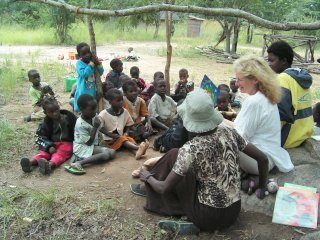
  • a pre-school (see picture above) - no building, but the children and teachers are doing wonderful work,
  • kitchen facilities with wood cooking facility that uses minimal wood,
  • library of books on a wide range of practical subjects,
  • multiple dwellings and meeting rooms made with earth bricks using a cinva ram, and local thatch,
  • vegetable gardens and young fruit trees.
To see pictures from these first two days at Kufunda, click here.

There is probably much I missed in this list, but it gives you a feeling for the steps they have taken towards self-reliance in four short years, while also assisting many other villages to begin this process - but those stories are still to come. . .

Sunday, February 26

Zimbabwe today

Reading these just-in news reports about Zimbabwe, while packing my bag, brought up the fear, not just for my life, but fear that if confronted by the realities, I would either feel too much, or shut down and not feel at all.

I'll try to post something now and then on this blog.

The caption that went with this picture:
As Zimbabwe's drought has worsened, the goal of providing 'supplementary' food for children has lost its meaning. This school lunch is the the first, and only, meal these children will have all day.

Killer Drought Threatens East Africa
In cracked riverbeds once flowing with water, dozens of hippos lie decomposing in the stifling heat. The thin, delicate frames of rare Grevy's zebras lie on parched grass, felled by anthrax. The wildlife in East Africa is dying of thirst and starvation, the people are suffering - and now the lack of rain threatens even the Serengeti migrations.


Zimbabwe's shortages, inflation blamed for rise in illegal abortions
HARARE, Zimbabwe (AP) -- The corpses of at least 20 newborn babies and fetuses are found each week in the sewers of Zimbabwe's capital, some having been flushed down toilets, Harare city authorities said, according to state media Friday.

Zimbabwean Women Protesters Held

About 200 women are in police custody in the Zimbabwe capital, Harare, after a protest on Tuesday over food prices and human rights violations.

responsible travel?

When Kim and I first discussed the idea of traveling to Africa prior to the baby getting too much bigger in her belly, the first question I wanted answered was how does one offset the impact that this amount of air travel represents?

After a while I let this issue slide for a while, until my dear friend Laurence forced it firmly back into my consciousness again, with some challenging questions.


Here is the answer as best as I can find out, though I would welcome any more information or discussion - please add your comments to this post.


Using travelnotes.org I calculated that the round trip distance is 43,000 Km. According to information I found it would require 24 trees to be planted in order to offset the carbon dioxide produced for one person to travel this distance.

So
in order to account for this trip, over the next twelve months I will plant 50 trees - and then keep a watchful eye to give them the best chance of surviving and growing to healthy oxygen-producing, carbon dioxide-locking trees, over the coming years.

"In 1999 the world's leading climate scientists estimated that 600 million tonnes of carbon dioxide a year was pumped into the earth's atmosphere through flying," says Graham Simmonds, chief executive for Trees for Cities. "

To put it another way, flying accounts for 3.5 percent of mankind's contribution to global warming, so it is serious business."
Flying business class also leaves a larger carbon footprint, since executive seats take up a lot more space in an airplane -- Simmonds believes the footprint is up to 50 percent larger than sitting in economy.

One option is to offset emissions by planting trees that absorb carbon dioxide. For a round trip from London to New York, which covers 11,000 kilometers (6,200 miles) and produces 1.4 tonnes of carbon dioxide, you need to plant six trees.
For a short haul return flight from Auckland to Wellington, a distance of 1,300 kilometers, you need two trees to absorb the 250 kilos (550 lbs) of carbon dioxide.


Tuesday, February 21

off to Africa

Today we booked flights, and we leave on Monday (27th) to fly to Zimbabwe and the Kufunda Learning Village where we will stay for two weeks.

Visiting Africa, and helping in the area of child development is something that Kim has wanted to do for a very long time.

Last year she helped establish a children's orphanage in Sri Lanka after the Tsunami. According to the UN,
there are more than 34 million orphans in Africa and some 11 million of them are orphaned by AIDS
, so I imagine there will be plenty to do.

Kim is 18 weeks pregnant now, so we thought it would be wise to go before the pregnancy got too far on and the baby consumed our attention for a while.

As well as helping out where I can, with a particular interest in permaculture, I am hoping to experience the culture of a small village population and see how they manage their own affairs. Considering what is happening in the country, I expect there will be plenty of examples of self-reliance I can learn from.