This was sent to me by a couple of people yesterday. It is brief and very well done...
Talk is rising of a ‘clash of civilizations’. But the problem isn’t culture, it’s politics – from 9/11 to Guantanamo, Iraq to Iran. This clash is not inevitable...
From avaaz.org
Showing posts with label Dialogue. Show all posts
Showing posts with label Dialogue. Show all posts
Friday, March 9


Individuality and Democracy
 Individuality and Democracy: A Way of Life
 At Sudbury Valley School, students from preschool through high school age explore the world freely, at their own pace and in their own unique ways...
Through self-initiated activities, they pick up the basics; as they direct their lives, they take responsibility for outcomes, set priorities, allocate resources, and work with others in a vibrant community.
Trust and respect are the keys to the school's success. Students enjoy total intellectual freedom, and unfettered interaction with other students and adults. Through being responsible for themselves and for the school's operation, they gain the internal resources needed to lead effective lives.
Independence
Students of all ages determine what they will do, as well as when, how, and where they will do it. This freedom is at the heart of the school; it belongs to the students as their right, not to be violated.
The fundamental premises of the school are simple: that all people are curious by nature; that the most efficient, long-lasting, and profound learning takes place when started and pursued by the learner. Read more...
Governance
The school is governed on the model of a traditional New England Town Meeting. The daily affairs of the school are managed by the weekly School Meeting, at which each student and staff member has one vote. Rules of behavior, use of facilities, expenditures, staff hiring, and all the routines of running an institution are determined by debate and vote at the School Meeting. At Sudbury Valley, students share fully the responsibility for effective operation of the school and for the quality of life at school. Read more...
This is the sort of school I would like my daughter to grow up in. Thanks Richard, for the link.
Sunday, February 4
calling a circle
Much of my time over the last few years, has been spent pondering just how we can connect to one another in these challenging times.
Everyone has their own story of struggling with different views, but recently this question has been prompted again for me by the 'development' of a neighbouring property. The scale of the work being done, which I am told is for a holiday home that will be occupied for a few weeks each year, seems a tad excessive, and even indulgent to me. Many weeks of heavy machinery and labour has gone into the landscraping, and unimaginable quatities of rainforest timber have been used to build a fence. I am told the project could cost as much as $3,000,000 by the time the dwelling and the caretakers residence are built - and that is a lot of resources.
When there is so much human suffering across the globe due to the global grab for resources, how can I connect with the person who claims ownership of this property? How can I share some of my concerns about the amount of energy and resources being used for personal and individual benefit? How can I make it safe for her to tell me how she sees things? I have begun the process by penning a very careful and gentle letter welcoming her to the island, but as yet no one has been willing to give me an address where I can send this.
Is it possible to see and feel one another's point of view, when they seem so different?
Here is one of a number of dialogue processes that I discovered on our trip to Zimbabwe last year. It has been very helpful to me in this search for meaningful and respectful dialogue.
---
Overview
For as long as humankind has been around, the circle has surely been with us. Human beings have naturally been gathering in circle, around the fire, sometimes in deep conversation, sometimes in the quiet space of simply being together. At its most essential level, the circle is a form that allows a group of people to slow down, practice deep listening, and truly think together. When practiced fully, it can be an embodiment of the root of the word dialogue: "meaning flowing through".
"Council" is another word, which expresses the promise of the circle. Imagine a circle of elders, passing a talking piece around one by one. Everyone's attention is on the person currently holding the piece, sharing his or her thoughts, perspectives, and wisdom. Each person's voice is valued and honoured. Long pauses of silence are an accepted part of the conversation.
People can meet in a circle as a once- off gathering, or coming together regularly over periods ranging from a few months to several years. In both these forms, and everything in between, the circle is in recent years making something of a comeback. From business executives in corporate boardrooms to community organizers in rural hinterlands, people are re-connecting with the value of sitting in circle.
Many of the processes described in this collection make use of chairs set up in a circle because it is generally the most suitable configuration for a dialogue. This section, however, looks specifically at Circle as a process in its own right, not only as a physical set up. We draw here on the guidelines developed by Christina Baldwin of PeerSpirit. Inspired by her exploration of Native American traditions, Christina wrote a book entitled "Calling the Circle", which has made a major contribution to re-introducing circle process and developing a set of practices that can help us to facilitate meaningful circle dialogues. These guidelines can be used in their entirety or held more lightly.
The circle is well known for the use of the talking piece. The talking piece is passed around the circle, with the person holding it being the only one to talk. The talking piece can be anything – an object from nature, a photograph, a pen, or even a cellphone. Some people think circle is only about working with talking piece council, but this is just one tool of the circle. Often the check- in is done with a talking piece, but then people can move into talking without it. This is called conversation council, where anyone who has something to say speaks. When people have been using circle for a while, even in conversation council, the practice is ingrained to not interrupt someone, and to let each person finish before a new person begins.
Elements of a circle
The circle is good for
Three practices of a circle dialogue
Essentially the circle is a space for speaking and listening, reflecting together and building common meaning. Three practices have been clarified, which can be useful to help people come into a higher quality of attention:
Three principles that help shape a circle.
Intention
As with most of the tools and processes of good dialogue, the starting point is with the purpose and intention. The intention will determine who should be invited to join, when, where and for how long they will meet, as well as what questions they will focus on.
The clearer the intention and the stronger the commitment to it, the stronger the circle. There are leadership circles, where people gather to support each other in their respective leadership practice. There are also circles that come together to solve a specific challenge such as improving a programme in an organization, or working together to make a neighbourhood more safe. It could be a group of workers coming together in circle with management to find the best way to deal with a need to retrench people, or even a group of homeless people joining members of a local church congregation to together come up with the best ways to support the homeless.
Sometimes a circle is more simply a tool used in a larger process during the course of a workshop, or as a weekly or monthly meeting in an organization, or community. In this case the intention is more informal – to share expectations, to connect with how each other is doing, and to surface and address any concerns or needs people may have.
The host
Although leadership is fully shared in circle, there will always be a host for the particular circle. Often the host is also the caller of the circle, but where a circle meets continuously over a longer period of time, the host role can change from circle meeting to circle meeting.
The host will ensure that the circle flows through its main phases and that the intention is at the centre of the dialogue. The host is often also responsible, with the "guardian" (see below), for the actual physical space. Special attention is paid to the physical centre of the circle – a colorful rug, some meaningful symbols or objects, and/or a plant may mark the centre of the circle and often represent the collective intention. This paying attention to the centre of a circle, brings with it a sense of the sacred, when people gather together around it. Something out of the ordinary is being invited in.
The Guardian
The Guardian is the person who pays special attention to the energy of the group, and that the group is not straying from the intention. The Guardian may interrupt during the course of the circle to suggest a break or a moment of silence. Sometimes conversation does speed up a little too much, and the centre – or calm – is lost. This is where the Guardian, or anyone who feels the need, can call the circle into reflection, or silent council, where everyone is silent for a while, letting things settle, before continuing either with the talking piece or in conversation council.
The flow of a typical circle
Welcome
The welcome helps the group shift into circle space. A good welcome can be a poem, a moment of quiet, or a piece of music to help people fully arrive, and to become present to each other and their circle.
Check-in
One thing that distinguishes a circle from many other ways of coming together is the importance placed on bringing each voice into the room. The circle therefore begins with a check-in where each person has a chance to speak to how they are feeling, as well as sharing their expectations for the meeting that day. The host may pose a specific question for each person to respond to in the check-in. It is also not unusual to invite participants to place an object representing their hope for the circle in the centre, sharing a little about the object as they do so. The result is a meaningful visual representation of the group's collective hopes in the center.
Agreements
When any circle gathers, its members need to formulate guidelines or agreements on how they wish to be together. This is an important part of shared leadership, and everyone taking responsibility for their time together. An example of commonly used agreements of circle are:
Farewell/Check-out
At the end of a circle, similar to the check-in at the beginning, there is now a check-out for people to share where they are at. The focus of the check-out can be as diverse as each circle. It can be on what people have learned, how they are feeling about what transpired, or what they are committing to do moving forward from the circle. Every participant usually speaks in the check-ins or check-outs unless they explicitly choose not to.
Case Example – Kufunda Village
At Kufunda Village – a learning centre focusing on rural community development in Zimbabwe – the circle has become a core part of the work with communities as well as the way the centre itself is run. Every time the centre does its evaluations of its programmes, or of the work in the communities themselves, the circle comes up as a key factor of success. People seem to connect fully with it, perhaps because it is a part of the traditional culture.
"The circle – we were brought up there. Round the fire was where conversation took place. Every evening we would sit around the fire, and talk." – Silas, Kufunda Village
At its simplest, there is a daily morning circle during community programmes in which each person checks in with how they are feeling around the programme, key learnings that survived the night and hopes and expectations for the day. The effect of using the circle with rural community organisers is that, where it might typically have been primarily adult men who would contribute, here everyone speaks. Slowly but surely, they build the confidence and naturalness of each person to contribute fully to everything that is done together. At the end of several programmes, men express their surprise at how much they have been able to learn in honest conversation with women (in the Shona system women and men often confer separately), or the elders from youth. The circle is taken back home to the communities that Kufunda works with, and it has become a natural way of meeting for all of the partner communities, allowing for the voice of the youth and the Chief alike to be expressed.
At Kufunda, a monthly team retreat day, where circle is used a lot (though not only) brings the team together in a more intimate way, giving space for people to express and work through concerns, needs or new ideas that may not make their way to the group during daily business.
Each team at Kufunda, meeting weekly, begin and end all their meetings with a talking piece check in, and check out. It means that people don't dive straight into business, but allow themselves to arrive and connect with each other, before getting into work. The check-out usually allows for reflection on how people are feeling about what was covered or decided. In times when the team struggles with misunderstandings, dedicated circle work has been invaluable in clearing the air – through a practice of truth-telling, choosing to listen without interrupting and jumping to defense. These are all aspects which the circle help promote.
The following list is a reflection on what the circle means both to Kufunda's employees and community partners from a series of evaluations done.
- The circle brings a sense of belonging
- Everyone contributes
- Everyone is a leader
- People speak from the heart
- Silence is ok
- It takes you out of your comfort zone
- It disrupts hierarchy
- It connects people
- It is intimidating
- It is liberating
- Everybody's voice is heard
- It is effective in conflict
- The circle is regulated by guidelines created by the group
- It fosters equality
Another example of a powerful use of circle is in the Alcoholics Anonymous (AA). Essential to the AA model are weekly meetings of alcoholics to be in dialogue and reflection together, bearing witness to each person's challenges and progress. At these meetings people can ask for help with personal problems in staying sober, and they get this help from the experience and support of others like them. There is no hierarchy, but it is rather a place to create a community of support for people who all share a desire to stop drinking and stay sober. It is a place where people can show up as who they are, letting their masks down, and not needing to hide their fear.
There are open and closed AA meetings. The closed meetings are the ones that most resemble circle as we've described it here. AA is sometimes ridiculed by those distant from it, but in reality, it is a very effective and creative organisation. The relationships and capacities people build at AA often turn out to be lifelong and relevant in a much broader range of situations.
Commentary
In our experience, up to 30 people (max 35) can be in a circle together. With 8-15 people one is able to go much deeper. It can also be used in larger processes, breaking the group into several circles. For this it does need someone familiar with the basics of circle to facilitate each group initially.
Another variation if the group is large can be to use the "fishbowl", or what is known as "Samoan Circles". Here, participants are divided between an active circle and an observer circle, with only the active circle speaking and the surrounding observer circle listening. The active circle can either be representative of the whole group, or of a sub-grouping, and sometimes it is set up so that people can move in between the the two circles. This process is particularly useful when issues are controversial, or if the group is large.
For many who are not used to the circle, the slowness of the conversation and thinking can be frustrating. With time most people learn to value and appreciate the gifts of slowing down together, to really listen to each other. Generally, people who tend to be less vocal and less powerful will appreciate the circle immensely because they are given the space to speak, while those who are used to dominating a conversation will be more frustrated.
It's worth noting that Social Science research has actually been done to show that the first person to speak can have a large influence on what is said and the direction the conversation takes. The circle seems particularly prone to this dynamic. This can be useful, but it can also be problematic. The way around it is to give people time to reflect in silence and collect their own thoughts before people start to speak. In general, the host should be aware that while the circle has a great equalising influence on a group, informal power dynamics still exist, and can influence the conversation.
Finally, there are rituals connected to some circle practitioners, which can be off-putting to some. The circle can be used in as ceremonial or as bare-bones a way as one wants.
Resources
The complete Mapping Dialogue book
http://pioneersofchange.net/library/dialogue/
Baldwin, Christina. Calling the Circle
http://www.peerspirit.com
http://www.fromthefourdirections.org
Everyone has their own story of struggling with different views, but recently this question has been prompted again for me by the 'development' of a neighbouring property. The scale of the work being done, which I am told is for a holiday home that will be occupied for a few weeks each year, seems a tad excessive, and even indulgent to me. Many weeks of heavy machinery and labour has gone into the landscraping, and unimaginable quatities of rainforest timber have been used to build a fence. I am told the project could cost as much as $3,000,000 by the time the dwelling and the caretakers residence are built - and that is a lot of resources.
When there is so much human suffering across the globe due to the global grab for resources, how can I connect with the person who claims ownership of this property? How can I share some of my concerns about the amount of energy and resources being used for personal and individual benefit? How can I make it safe for her to tell me how she sees things? I have begun the process by penning a very careful and gentle letter welcoming her to the island, but as yet no one has been willing to give me an address where I can send this.
Is it possible to see and feel one another's point of view, when they seem so different?
Here is one of a number of dialogue processes that I discovered on our trip to Zimbabwe last year. It has been very helpful to me in this search for meaningful and respectful dialogue.
---
Overview
For as long as humankind has been around, the circle has surely been with us. Human beings have naturally been gathering in circle, around the fire, sometimes in deep conversation, sometimes in the quiet space of simply being together. At its most essential level, the circle is a form that allows a group of people to slow down, practice deep listening, and truly think together. When practiced fully, it can be an embodiment of the root of the word dialogue: "meaning flowing through".
"Council" is another word, which expresses the promise of the circle. Imagine a circle of elders, passing a talking piece around one by one. Everyone's attention is on the person currently holding the piece, sharing his or her thoughts, perspectives, and wisdom. Each person's voice is valued and honoured. Long pauses of silence are an accepted part of the conversation.
People can meet in a circle as a once- off gathering, or coming together regularly over periods ranging from a few months to several years. In both these forms, and everything in between, the circle is in recent years making something of a comeback. From business executives in corporate boardrooms to community organizers in rural hinterlands, people are re-connecting with the value of sitting in circle.
Many of the processes described in this collection make use of chairs set up in a circle because it is generally the most suitable configuration for a dialogue. This section, however, looks specifically at Circle as a process in its own right, not only as a physical set up. We draw here on the guidelines developed by Christina Baldwin of PeerSpirit. Inspired by her exploration of Native American traditions, Christina wrote a book entitled "Calling the Circle", which has made a major contribution to re-introducing circle process and developing a set of practices that can help us to facilitate meaningful circle dialogues. These guidelines can be used in their entirety or held more lightly.
The circle is well known for the use of the talking piece. The talking piece is passed around the circle, with the person holding it being the only one to talk. The talking piece can be anything – an object from nature, a photograph, a pen, or even a cellphone. Some people think circle is only about working with talking piece council, but this is just one tool of the circle. Often the check- in is done with a talking piece, but then people can move into talking without it. This is called conversation council, where anyone who has something to say speaks. When people have been using circle for a while, even in conversation council, the practice is ingrained to not interrupt someone, and to let each person finish before a new person begins.
Elements of a circle
The circle is good for
- Enabling a group to connect more intimately
- Creating equality among people who are at different levels in a group, organization or community – giving equal value to each person, and requiring everyone to participate
- Slowing people down and allowing them to think together
Three practices of a circle dialogue
Essentially the circle is a space for speaking and listening, reflecting together and building common meaning. Three practices have been clarified, which can be useful to help people come into a higher quality of attention:
- Speak with intention: noting what has relevance to the conversation in the moment.
- Listen with attention: respectful of the learning process all members of the group.
- Tend the well-being of the circle: remaining aware of the impact of our contributions.
Three principles that help shape a circle.
- Leadership rotates among all circle members. The circle is not a leaderless gathering – it is an all leader gathering.
- Responsibility is shared for the quality of experience.
- People place ultimate reliance on inspiration (or spirit), rather than on any personal agenda. There is a higher purpose at the centre of every circle.
Intention
As with most of the tools and processes of good dialogue, the starting point is with the purpose and intention. The intention will determine who should be invited to join, when, where and for how long they will meet, as well as what questions they will focus on.
The clearer the intention and the stronger the commitment to it, the stronger the circle. There are leadership circles, where people gather to support each other in their respective leadership practice. There are also circles that come together to solve a specific challenge such as improving a programme in an organization, or working together to make a neighbourhood more safe. It could be a group of workers coming together in circle with management to find the best way to deal with a need to retrench people, or even a group of homeless people joining members of a local church congregation to together come up with the best ways to support the homeless.
Sometimes a circle is more simply a tool used in a larger process during the course of a workshop, or as a weekly or monthly meeting in an organization, or community. In this case the intention is more informal – to share expectations, to connect with how each other is doing, and to surface and address any concerns or needs people may have.
The host
Although leadership is fully shared in circle, there will always be a host for the particular circle. Often the host is also the caller of the circle, but where a circle meets continuously over a longer period of time, the host role can change from circle meeting to circle meeting.
The host will ensure that the circle flows through its main phases and that the intention is at the centre of the dialogue. The host is often also responsible, with the "guardian" (see below), for the actual physical space. Special attention is paid to the physical centre of the circle – a colorful rug, some meaningful symbols or objects, and/or a plant may mark the centre of the circle and often represent the collective intention. This paying attention to the centre of a circle, brings with it a sense of the sacred, when people gather together around it. Something out of the ordinary is being invited in.
The Guardian
The Guardian is the person who pays special attention to the energy of the group, and that the group is not straying from the intention. The Guardian may interrupt during the course of the circle to suggest a break or a moment of silence. Sometimes conversation does speed up a little too much, and the centre – or calm – is lost. This is where the Guardian, or anyone who feels the need, can call the circle into reflection, or silent council, where everyone is silent for a while, letting things settle, before continuing either with the talking piece or in conversation council.
The flow of a typical circle
Welcome
The welcome helps the group shift into circle space. A good welcome can be a poem, a moment of quiet, or a piece of music to help people fully arrive, and to become present to each other and their circle.
Check-in
One thing that distinguishes a circle from many other ways of coming together is the importance placed on bringing each voice into the room. The circle therefore begins with a check-in where each person has a chance to speak to how they are feeling, as well as sharing their expectations for the meeting that day. The host may pose a specific question for each person to respond to in the check-in. It is also not unusual to invite participants to place an object representing their hope for the circle in the centre, sharing a little about the object as they do so. The result is a meaningful visual representation of the group's collective hopes in the center.
Agreements
When any circle gathers, its members need to formulate guidelines or agreements on how they wish to be together. This is an important part of shared leadership, and everyone taking responsibility for their time together. An example of commonly used agreements of circle are:
- Listen without judgment
- Offer what you can and ask for what you need
- Confidentiality – whatever is said in circle, stays in circle
- Silence is also a part of the conversation
Farewell/Check-out
At the end of a circle, similar to the check-in at the beginning, there is now a check-out for people to share where they are at. The focus of the check-out can be as diverse as each circle. It can be on what people have learned, how they are feeling about what transpired, or what they are committing to do moving forward from the circle. Every participant usually speaks in the check-ins or check-outs unless they explicitly choose not to.
Case Example – Kufunda Village
At Kufunda Village – a learning centre focusing on rural community development in Zimbabwe – the circle has become a core part of the work with communities as well as the way the centre itself is run. Every time the centre does its evaluations of its programmes, or of the work in the communities themselves, the circle comes up as a key factor of success. People seem to connect fully with it, perhaps because it is a part of the traditional culture.
"The circle – we were brought up there. Round the fire was where conversation took place. Every evening we would sit around the fire, and talk." – Silas, Kufunda Village
At its simplest, there is a daily morning circle during community programmes in which each person checks in with how they are feeling around the programme, key learnings that survived the night and hopes and expectations for the day. The effect of using the circle with rural community organisers is that, where it might typically have been primarily adult men who would contribute, here everyone speaks. Slowly but surely, they build the confidence and naturalness of each person to contribute fully to everything that is done together. At the end of several programmes, men express their surprise at how much they have been able to learn in honest conversation with women (in the Shona system women and men often confer separately), or the elders from youth. The circle is taken back home to the communities that Kufunda works with, and it has become a natural way of meeting for all of the partner communities, allowing for the voice of the youth and the Chief alike to be expressed.
At Kufunda, a monthly team retreat day, where circle is used a lot (though not only) brings the team together in a more intimate way, giving space for people to express and work through concerns, needs or new ideas that may not make their way to the group during daily business.
Each team at Kufunda, meeting weekly, begin and end all their meetings with a talking piece check in, and check out. It means that people don't dive straight into business, but allow themselves to arrive and connect with each other, before getting into work. The check-out usually allows for reflection on how people are feeling about what was covered or decided. In times when the team struggles with misunderstandings, dedicated circle work has been invaluable in clearing the air – through a practice of truth-telling, choosing to listen without interrupting and jumping to defense. These are all aspects which the circle help promote.
The following list is a reflection on what the circle means both to Kufunda's employees and community partners from a series of evaluations done.
- The circle brings a sense of belonging
- Everyone contributes
- Everyone is a leader
- People speak from the heart
- Silence is ok
- It takes you out of your comfort zone
- It disrupts hierarchy
- It connects people
- It is intimidating
- It is liberating
- Everybody's voice is heard
- It is effective in conflict
- The circle is regulated by guidelines created by the group
- It fosters equality
Another example of a powerful use of circle is in the Alcoholics Anonymous (AA). Essential to the AA model are weekly meetings of alcoholics to be in dialogue and reflection together, bearing witness to each person's challenges and progress. At these meetings people can ask for help with personal problems in staying sober, and they get this help from the experience and support of others like them. There is no hierarchy, but it is rather a place to create a community of support for people who all share a desire to stop drinking and stay sober. It is a place where people can show up as who they are, letting their masks down, and not needing to hide their fear.
There are open and closed AA meetings. The closed meetings are the ones that most resemble circle as we've described it here. AA is sometimes ridiculed by those distant from it, but in reality, it is a very effective and creative organisation. The relationships and capacities people build at AA often turn out to be lifelong and relevant in a much broader range of situations.
Commentary
In our experience, up to 30 people (max 35) can be in a circle together. With 8-15 people one is able to go much deeper. It can also be used in larger processes, breaking the group into several circles. For this it does need someone familiar with the basics of circle to facilitate each group initially.
Another variation if the group is large can be to use the "fishbowl", or what is known as "Samoan Circles". Here, participants are divided between an active circle and an observer circle, with only the active circle speaking and the surrounding observer circle listening. The active circle can either be representative of the whole group, or of a sub-grouping, and sometimes it is set up so that people can move in between the the two circles. This process is particularly useful when issues are controversial, or if the group is large.
For many who are not used to the circle, the slowness of the conversation and thinking can be frustrating. With time most people learn to value and appreciate the gifts of slowing down together, to really listen to each other. Generally, people who tend to be less vocal and less powerful will appreciate the circle immensely because they are given the space to speak, while those who are used to dominating a conversation will be more frustrated.
It's worth noting that Social Science research has actually been done to show that the first person to speak can have a large influence on what is said and the direction the conversation takes. The circle seems particularly prone to this dynamic. This can be useful, but it can also be problematic. The way around it is to give people time to reflect in silence and collect their own thoughts before people start to speak. In general, the host should be aware that while the circle has a great equalising influence on a group, informal power dynamics still exist, and can influence the conversation.
Finally, there are rituals connected to some circle practitioners, which can be off-putting to some. The circle can be used in as ceremonial or as bare-bones a way as one wants.
Resources
The complete Mapping Dialogue book
http://pioneersofchange.net/library/dialogue/
Baldwin, Christina. Calling the Circle
http://www.peerspirit.com
http://www.fromthefourdirections.org
Tuesday, December 19
wisdom council
 Here is a Quicktime audio file that is worthy of your attention if you are curious about the way forward, and how we will manage our affairs in the coming years. It has long been my opinion that the way forward will come from the ground up, rather than top down.
 The Center for Wise Democracy has developed a social invention called the "Wisdom Council," which provides a new systems approach to solving many of today's most pressing social issues—failing education, loss of community, citizen apathy, diminished economic viability prejudice, terrorism, poverty, exorbitant health care costs, partisanship, breakdown of families, global warming, wars, etc.
It's not a long audio, and well worth the time as it explains quite well how it is structured and why it works.
Friday, June 23
conversation and dialogue

From Transition Culture, yet another poignant article/interview. . .
What are the skills we need to learn and the training & education we need to put in place to respond to peak oil?
We really need to understand the value, and give a value, to loosening up our minds, becoming curious rather then certain, being interested beyond the polarities of the differences, being really interested in how someone else experiences this issue, or any issue. You can educate people into becoming more curious, but it's a serious process. We're certainly not doing in our schools, we're not doing it in our organizations where we just want people to make snap decisions, we want children to give instant simplistic answers…
If you are interested in the subject of effective dialogue, you can read an excerpt and download a full 80 page document here.
Wednesday, April 19
creative descent
 In a conversation last Saturday night, a friend talked about the concept of changing our lives in order to live within our means. Is it me, am I attracting people thinking this way, or is there a owowing awareness of these issues because they are becoming critical to our future well-being and even survival?
While permaculture strategies mesh nicely with many of those directed towards this generally accepted desirable future, permaculture in fact defines a creative response to a fourth scenario that I call “Earth Stewardship” - a “creative descent” in which we progressively reduce our energy demands to return eventually to living within the natural energy and production budget of the land we occupy. Elements of all these scenarios can be found in the wide-ranging viewpoints and arguments of today’s “sustainability” debates.
In the Earth Stewardship “creative descent” scenario, which I consider to represent the only truly sustainable future, human society creatively descends the energy demand slope essentially as a ‘mirror image’ of the creative energy ascent that occurred between the onset of the industrial revolution and the present day. The actual sustainable plateau is a long way down from current energy demands, but also a long way ahead in time. If we begin our journey now, there is time to use our familiarity with continuous change and creative innovation to avoid bringing on “Atlantis”.
So, in an energy-descent future, what are the prospects close to home - here where we live in suburbia? Will it be the end of suburbia? What if we can no longer afford to commute to work by car? What if we are dependent on food and energy supplies that are transported long distances at increasing expense? What if the services and functionality of our communities decline further so that there is ever-diminishing support from local councils and police, for example?
There is a real and viable alternative to this seemingly alarming scenario - a retrofit of suburbia - a remodelling of local neighbourhoods and communities for the energy-descent future. The “refit manual” will bring together and integrate features such as:
- Home-based work, telecommuting, and cottage industries serving a local clientele;
- Extended families, lodgers and shared households;
- Recycling of storm water, waste water, and human waste;
- Soils of improved fertility, and the water supply and infrastructure for urban agriculture;
- City farms, cooperative gardening, Farmers’ Markets, and Community Supported Agriculture schemes (CSAs)
Community Supported Agriculture (CSA) is a scheme in which customers undertake to buy a regular box of in-season fruits, vegetables, eggs, etc. from one or more local producers, thus providing the latter with a secure income and the ability to diversify the types of produce they provide.
The bottom line here is that we do not need to wait for policies to change. We can choose today to do this - to create our own small neighbourhoods. ‘Suburban sprawl’ in fact give us an advantage. Detached houses are easy to retrofit, and the space around them allows for solar access and space for food production. A water supply is already in place, our pampered, unproductive ornamental gardens have fertile soils and ready access to nutrients, and we live in ideal areas with mild climates, access to the sea, the city and inland country.
So what do we have to do to make it work? Basically, the answer is “Just do it!” Use whatever space is available and get producing.

Involve the kids - and their friends. Make contact with neighbours and start to barter. Review your material needs and reduce consumption. Share your home - by bringing a family member back or taking in a lodger, for example. Creatively and positively work around regulatory impediments, aiming to help change them in the longer term. Pay off your debts. Work from home. And above all, retrofit your home for your own sustainable future, not for speculative monetary gain.
In an energy-descent world, self-reliance represents real opportunities for early adopters of a permaculture life style:
- Rises in oil prices will flow through to all natural products (food, timber, etc);
- Higher commodity prices will be a stimulus for self-reliance and organic farming;
- Local products will be more competitive than imports;
- Repair, retrofitting, and recycling will all be more competitive than new replacement;
- There will be rising demand for permaculture as life-skills eduction; and
- There will be a resurgence of community life, ethics and values.
There are, however, some real hazards for the greater community in the energy-descent scenario. For example, perverse subsidies and “head-in-the-sand” policies could distort necessary market adjustments (e.g., the end of fuel tax combined with production subsidies to agribusiness). There is a real danger that fascist-style politics could see minorities and those providing for themselves as being to blame for declining social conditions.
Sudden economic and environmental shocks could conceivably lead to social collapse, removing even the security necessary for local food production. We need to understand the energy-descent pathway ahead, act to ensure our own longer-term resource security, and keep ourselves informed about the viewpoints and approaches of the greater national and global communities around us.
Links:
A huge resource with downloadable audio
THE END OF SUBURBIA: Or the Beginning of Widespread Permaculture?
Energy Bulletin - link to full article this is excerpted from
Energy Bulletin - An easily negotiated and thorough site
--- 0 ---
Kim and I hosted an event at the local cinema last night to speak about our trip to Zimbabwe, and to share in an experiential way, the dialogue process of Calling the Circle. Judging by people's expression in the circle, and the gratitude expressed at the end of the night, it was well received. It seems that people are hungry to be heard, and to be in a safe place where those things that are most important, relevant and urgent in their thoughts and feelings, can be expressed.
Friday, April 14
Mapping Dialogue

This document was for me, the major gift of a two week visit to the Kufunda Learning Village in Zimbabwe. You can download the document from here
"An answer is always the part of the road that is behind you. Only questions point to the future." - Jostein Gaarder
Here's an excerpt from the Introduction:
The modern world loves answers. We like to solve problems quickly. We like to know what to do. We don't want to "reinvent the wheel". We don't want to "waste our time". And when we have the answers or have a wheel invented we like to pass on the information to others. We do this through the media, through training programmes where teachers pass on answers to students, or through conferences where experts speak on panels while hundreds listen (or pretend to listen) in the audience. This approach may be useful for some situations, but is problematic for a number of reasons, particularly when working on social and human challenges in the 21st century.
Firstly, we live in a world of increasing complexity, where answers have a short life-span. Adam Kahane in his recent book "Solving Tough Problems" (2004) points out that tough problems are characterised by three types of complexity. Dynamic complexity means that cause and effect are distant in space and time. To address this type of complexity you need a systemic approach to the problem and the solution. Social complexity means that there are many different and usually conflicting points of view and assumptions about the issue, and the problem isn't owned by a single entity. This demands a participative approach. Finally, generative complexity means that the old solutions are no longer working, and the problem is constantly changing and unpredictable, which requires a creative approach. Not all problems are dynamically, socially, and generatively complex, but most if not all of the major social issues South Africa as a country is currently trying to work through are. Hiv/AIDS, black economic empowerment, democratic transition, globalisation, unemployment, and crime are all perfect examples.
Secondly, it seems to us that people have an inherent desire to want to solve their own problems. When universal, formulaic responses are imported or imposed from the outside, they meet resistance and often fail. This is partly because they are not exactly appropriate in the given context, but just as much because there is a lack of ownership from people who haven't participated or been consulted in the decision-making. Human beings have a living, deep impetus for freedom and self-determination, and given appropriate circumstances, people are usually more resourceful than expected in terms of finding their own answers.
They buy in to, and own, solutions they have been a part of creating. The success of implementing interventions on social issues often depends more on ownership and motivation of those involved than on the cleverness of the idea.
Even if only for these two reasons, we need to be adept at asking questions, and at talking and listening to each other. These are age-old competencies. For millennia, people in villages across Africa have worked through collective challenges, creating solutions through conversation. But it is not only when the group is faced with problems that dialogue comes in. Life in an African community is an ongoing conversation.
Why is this art of talking declining? Many of us seem to have forgotten how to engage in, and be present to, such conversations. In these times of busy-ness, information overload, electronic communications, scientific rationality, and organisational complexity, we are forgetting how to talk to each other. Fortunately, as a response to this trend, a number of methods for facilitating dialogue have been emerging globally, in particular over the past 20 years.
This collection profiles 10 such methods in depth and a number of others more briefly. The approaches are diverse in many ways. Some are designed for small groups of 20 people, some can accommodate up to 1200 or even 5000 in dialogue at the same time. Some focus on exploring and resolving conflict and differences, while others emphasise looking first to what is working and agreed upon. Some are explicitly dialogues between groups while others require each participant to be there only as themselves and individuals.
Yet across all these dialogue methods are some clear common patterns. They focus on enabling open communication, honest speaking, and genuine listening. They allow people to take responsibility for their own learning and ideas. They create a safe space or container for people to surface their assumptions, to question their previous judgments and worldviews, and to change the way they think. They generate new ideas or solutions that are beyond what anyone had thought of before. They create a different level of understanding of people and problems. They allow for more contextual and holistic ways of seeing. They lead to "a-ha" experiences.
Each of the profiled approaches has a life story behind it. Many of these stories begin with a person who posed a question. "How do the questions we ask shape our reality?" "Given that the coffee breaks seem to be the most useful part of the conference anyway, what if the whole conference was designed similar to a coffee break?" "What is being lost when we just take majority decisions and don't hear what the minority has to say?" "How do we create a networked conversation, modeled on how people naturally communicate?" "Why are we recreating the same conference rituals when they are passifying us and limiting our creativity?" "Why are we not managing to bring in the collective intelligence of hundreds of people but rather choosing over and over to just listen to a few expert voices?"
These inquisitive characters proceeded to experiment with new ways of organising conversations. They drew inspiration from indigenous cultures, lively cafés, international peace processes, and personal experiences of trial and error. The result is the potpourri of possibilities described in the following pages.
You can download the document from here
Saturday, March 25
Open Space Technology
 It has only been a few days since we arrived and already I feel deep gratitude for the people and their heart. The invitation to participate in an Open Space technology event one day, was a welcome chance to offer something , anything, back to the Kufunda community.
 Open Space Technology was created in the mid-1980s by organizational consultant Harrison Owen when he discovered that people attending his conferences loved the coffee breaks better than the formal presentations and plenary sessions.
Combining that insight with his experience of life in an African village, Owen created a totally new form of conferencing. Open Space conferences have no keynote speakers, no pre-announced schedules of workshops, no panel discussions, no organizational booths. Instead, sitting in a large circle, participants learn in the first hour how they are going to create their own conference. Almost before they realize it, they become each other's teachers and leaders.
There are some simple rules to this process and Kim and I both enjoyed being on the side of giving from our knowledge, to this community which is so open to listening and considering new ideas to see if they may be applicable and helpful.
Kim spoke with some women about different approaches to early childhood education, and I demonstrated a method of low energy cooking.
A common site was women carrying big loads of firewood on their heads - wood is the only cooking fuel for a lot of communities, and deforestation is a real issue. The Kufunda community is playing their part by helping others communities build efficient fireplaces (using material from old termite mounds).
My offering was to show how it is not necessary to keep a pot boiling in order to cook food, but if it is brought to the boil then kept highly insulated, it will continue to cook - just more slowly. So we put some rice in some cold water, brought it to the boil and put it in a large carboard box stuffed with straw, so that the pot was surrounded on all sides. 30 minutes later it was cooked. This fuel saving method was well received and because it was demonstrated, will probably be embraced.
While our experience of Open Space (one of the simplest, most brilliant combinations of order and chaos, which is most powerful when conducted over two or three days) was very brief, it offered a delicious taste of what it could be.
Saturday, March 18
calling a circle
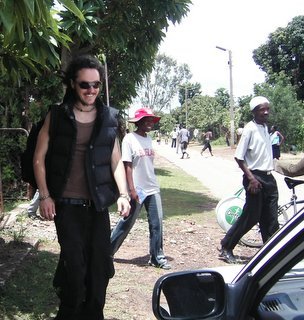 On the afternoon of the first day, Marianne and several of the other Kufundees invited us into a Circle. This was the first indication that this community was being built with processes that were simple, real and practical.
 We were introduced to the idea that learning can be exchanged between everyone. When we open ourselves to receive from others and when we assume we have something to give no matter what we assume is our 'position' in society, our experience, knowledge, qualifications, or how much paper (money or property titles) anyone holds.
That evening we went to Harare for a night of comedy in the Book Cafe. Happily these brave people were able to bring their much needed humour to address the political madness that surrounds them.
The next day we had a trip to Highfield, a ghetto in Zimbabwe's capital of Harare. This was, in Chris' words, "where we met some righteous youths fighting to make a difference in their community with permaculture, art and wisdom as their weapons."
We were invited into their humble house where the Highfield activists called a circle and introduced us to the various collectives that made up their group and what each one was engaged in.
The Arts Collective included activities such as the Theatre of the Oppressed (I hope to get some video material from them). The Media Collective who were printing and communicating their own news. The Permaculture Collective who were networking and involved in health issues and growing food. And The Labour Collective who supported Labour Unions and other Civil Organisations. Kim said it was how she imagined a visit to a Black Panther meeting in the US might have been back in the days when they were a force for positive change in their community in the US.
It was during and after this visit that I periodically experienced a persistent flow of moisture from my eyes and become aware of a cramp in my chest, which I was able to relax through to some extent. It was an experience that continued throughout the 12 days we were with these Kufundees and all the other spirited people they introduced us to.
These are mostly young people who know that the future is in their hands. Maybe the fact that Kim and I are expecting a baby in July had something to do with the emotions I felt.
When we gathered again in a circle back at Kufunda, to share the feelings and thoughts about the Highfield visit, Marianne touched a nerve for me by expressing that she felt a sense of "no hope, but not despairing." I wonder where hope comes from? Is it a sense of having a ticket in a lottery that we hope we might win and that outside forces will take care of everything for us?
My feeling is that the Highfield community have said "enough!" and are now working to build their community up from there. They are not willing to descend any further and in that sense I feel that they are ahead of us, living as we do in our comfortable homes consuming the planets blood/oil. It seems that we have yet to come to that point.
For more pictures from this day click here.
Links to more information about "Calling a Circle"
Buy Calling the Circle from Amazon
View and download guidelines for Calling a Circle
I will post more in the coming days, and the big lessons didn't come until the last days. :-)
Tuesday, February 21
Achieving real democracy

Here is Richard's blog - the author of "Escaping the Matrix." It may be that we have a chance to host him here on Waiheke and engage in a harmonisation process - a way of finding common ground amongst a group of people with disparate points of view.
Sound like fun?
Let me know if you are interested.
Subscribe to:
Posts (Atom)