skip to main |
skip to sidebar
 From Harvey Jones:
The article below was in our local newspaper last night. Eketahuna is a small town of only about 1,000 or less people, nearby my home town of Pahiatua (pop 3,000).
There has been a running down in New Zealand of various local services. At Eketahuna the local community are taking things into their own hands. A few years ago the petrol station burned down and none of the oil companies wanted to be part of any rebuilding.
The town created a community trust which all local members were invited to contribute to. From this, they funded the building of a new service station. Now there is no need to travel 25 kms to fill the tank.
A hardware store was similar funded. There is no doctor in the town so they organised a community nursing service to provide a front line service and reduce travel needs. Now a banking service as well.
I noted that there is no history of their previous accomplishments in the article below. Now we have to find ways to grow the movement and share the expertise.
____________________
Original source URL:
http://stuff.co.nz/manawatustandard/4108644a6502.html
Tuesday, 26 June 2007
Do-it-yourself banking arrives
The small Tararua town of Eketahuna is taking Do It Yourself to whole new levels.
It didn't have a supermarket, so it created its own. It didn't have a petrol station, so it set one up.
Now, the town is taking banking into its own hands as well.
After all the major banks refused to put either a branch or automatic teller machine in Eketahuna, locals decided to set up a money exchange. The exchange was the brainchild of Tararua district councillor Claire Matthews, a banking studies senior lecturer. She said Eketahuna's population of about 500 made it too small for a bank. "It's purely a question of profit. It would not be economically viable." An exchange was the obvious solution, after seeing similar systems in other small towns. "A bank branch is only of use if you are with that bank, and an ATM really only allows withdrawals, which may attract higher fees for customers of other banks. I suggested a money exchange, as I had seen in Northland." Mrs Matthews said not having banking services was frustrating for people in Eketahuna, where the nearest bank facilities were 25km away in Pahiatua.
The exchange will be run by staff in the council's service centre and will aim to break even rather than make a profit, with the council subsidising the operation for the first six months on a trial basis. It will provide access to cash through an eftpos machine, change for businesses, cash or cheque deposits, and cheque cashing for approved customers. Deposits will go by courier to banks in Masterton. It is expected to be up and running by August.
 Helen Dew in her potato patch - another liberated lawn.
She recently sent me some Leek seeds, with a note to "Sow leeks now, for good sized crop in winter. Love, Helen" I got them in some seedling pots on New Years eve. Thank you Helen for this lovely gesture of support, you are an inspiration. Here are the pots with Helen's leek seeds in - protected from the birds and the drying effect of the sun. I aded some dry worm castings, harvested a year ago, to the potting mix. I only planted half the seeds, as I recall that the period following the full moon is said to be better for root crops.
People rarely write or talk about their gardens until they have perfected some aspect of them. It is easy to feel daunted by all the volumes of books and articles on the subject. Where do we start! My friend Scott has often expressed the basic truth that "you don't need to know all the answers before you begin."
 A Growing Opportunity
Urban agriculture takes root in empty lots and abandoned spaces
Don Butler
The Ottawa Citizen Sunday,
June 18, 2006
Argentina's 2001 meltdown hit the city of Rosario hard. Fully 800,000 of its 1.2 million residents were plunged into poverty because of widespread unemployment caused by the economic crash.
To cope, the city, located about 300 kilometres northwest of Buenos Aires, turned to a seemingly quixotic strategy -- urban agriculture.
It turned over public land, offered tax breaks to owners of vacant lots who agreed to let poor residents grow organic produce on their property, and began to supply tools, seeds and other supplies.
Before long, more than 800 community gardens had sprung up, supporting 10,000 farmers and their families. What they didn't need for themselves, they could sell in one of seven new farmer's markets established by the city. Read on...
Hi Helen,
I was up at 6:00 this morning to meditate, and was drawn to spend an hour transplanting seedlings from a tray into pots of six seedlings in each. 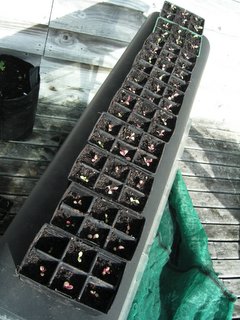 I now have 60 healthy Loose Leaf Mixed Lettuce seedlings, and to my amazement I have only taken from one fifth of the tray! Just one of those packets you sent me held 300 viable seeds. What abundance!
 It was delightful contemplating what a lovely gesture of mutual support that gift of seeds from you was.
Economics is everything people do for each other. Whether actions are taken for love, barter or money, they contribute to mutual provision. I use the phrase "mutual provision" synonymously with "economics" to make it clear that the whole process is, in essence, about people taking care of each other. This reassuring perspective is often lost in the shadow of the competitive economic model now in command. To the extent that the present model no longer serves the common good, it will change as conventional wisdom recognizes the deviation. - Mike Nickerson
I have been focusing on the money systems and looking for these wonderful human gestures which will ultimately transcend and transform the money system as we know it.
Thank you,
James

Looking at the bright new shiny, and shrunken, coins I wonder if any one else notices how much they have devalued? A friend pointed out to me the similarity between the bright new shiny copper 10c piece, and the 1c coin we used to have - the main noticeable difference is that the new one has a zero on it the old one didn't. Is that how much value the money has lost?
I hear the cry: "It's too complicated" How are we to understand these serious and complicated economic issues, and if we did what could we do about them? We easily pass on the responsibility to others who know better - and they work in our best interests, no? A paragraph by David C. Korten in his latest book "From Empire to Earth Community," clarified this very succinctly for me. Maybe it will help you.
These financial games [interest bearing loans, manipulated interest rates, financial speculation, and more] contribute nothing of value to the larger society. They do, however, significantly increase the buying power of the ruling elites and their claims on the real wealth of society relative to the claims of those persons who contribute to the creation of that wealth by producing real goods and providing real services. They are the most successful of financial cons because the mechanisms are invisible and the marks—the object of the con—rarely realise they have been conned. Even if they were to recognise they have been conned, there is nothing they can do about it because the con is both legal and culturally accepted. - David C. Korten
Those words stopped me in my tracks. Of course. Has anyone noticed that many of the productive people in our community, are living on the same or similar incomes they lived on 10 years ago when our money could buy more? We are working longer hours, or now we constitute part of a two income family, just to maintain the same level of purchases. And it goes on. While we look at local economics, we are not isolated from the economies of the world. And those economies are even harder to comprehend. However the secretive nature of those institutions who control the world economics is worth noting:
"Today the world is run by three of the most secretive institutions in the world: The International Monetary Fund, the World Bank, and the World Trade Organization, all three of which, in turn, are dominated by the U.S. Their decisions are made in secret. The people who head them are appointed behind closed doors. Nobody really knows anything about them, their politics, their beliefs, their intentions. Nobody elected them. Nobody said they could make decisions on our behalf." – Arundhati Roy
And they are working in our best interests, right?
 LET US WORK TOGETHER
The CES did start out as a new software package for a single trading group in Cape Town, South Africa. Its success soon attracted the attention of others and similar groups were set up all over South Africa. Later it got adopted in New Zealand and now it is operating in seven countries worldwide. Our vision is that CES should become a co-operative project and that it should do what its users want it to do.
Although I have prescribed above how LETS groups that have adopted CES should operate, there are no rules. CES can be used as a software package to run a single group in the traditional way, or we can develop it together to create a really effective, new money system.
This document is meant as an appeal to those attending this conference to adopt the grand vision of the founders of CES. That is, we are doing this because we believe the present global money system is at the root of most of the social, economic, political and environmental problems that confront us today. We can only begin to tackle these problems if we have a money system that places the ‘money power’ in the hands of the people who use it. We can build this new money system if we work together and share resources. That way we will ensure that we build something adaptable and scalable, that caters for all our needs and achieves the ultimate goal of creating a new, healthy money system.
Tim Jenkin, CES
 Who creates the money?
From the previous post, the answer to this question "Who creates it?" is not "the government", or "the country's central bank", but the commercial banks.
This seems truly remarkable - that we allow a few greedy bankers to control our primary mechanism of exchange. The propoganda machine has done its job well, since most of us believe that the present arrangement is the only way it can work.
Who benefits from this arrangement?
Perhaps more remarkable is that there is no attempt to hide this fact. In his well-known economics textbook, David Begg states: "Modern banks create money by granting overdraft facilities in excess of the[ir] cash reserves" He adds: "Bank-created deposit money [the money that people can draw from their bank accounts] forms by far the most important component of the money supply in modern economies."
Dishonest goldsmiths
So how did money creation come to be privatised? This query takes us back to the late Middle Ages when gold and silver coins were the main form of money. I recommend this article, which explains the basis of our present system. Did you know the Federal Reserve Bank of America is a privately owned corporation! I don't know about our own NZ Treasury - does anyone?
Where to from here?
If we allow ourselves to be informed, we can, by general agreement, decide to change these absurd arrangements. While watching a film titled "Alternative Currencies," I saw some inspiring and wonderful footage of people who have been using their own community currencies for years, and some direct challenges to the dominant, centralised, and abusive banking model.
There are several New Zealand examples of local regions who are using a complimentary currency, and now that they have all (but one) agreed to use the computerised CES system, there is now the ability to 'intertrade' between regions. For more information about what is happening in New Zealand the Living Economies website is a good starting point.
It's a small beginning, but an exciting and valuable one, that I imagine will grow in years to come. Anyone interested in starting up a Waiheke Currency?
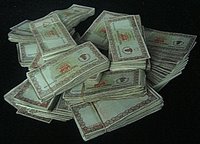 I believe that every event, every meeting, every moment of life is an opportunity to learn. Even though first impressions of people, situations and events may lead one to assume that this is otherwise, a small gesture of openness is often all that is required. I confess that on arrival at the slightly run down DOC camp in the back blocks of Taranaki, I had to tell myself "there is something to learn here" and with that throw myself into conversations - that I am happy to report revealed a circle of dedicated people who had lots to teach me.
The LETS movement in New Zealand has had its moments of growth and decline - often in synch with the relative buoyancy of the market economy in which we find ourselves functioning. When people are "down on their luck" they will often turn to the complimentary currencies and find them to be a useful means of managing exchanges of goods and services which they might otherwise not be able to access, due to a lack of cash. Unfortunately if people are not educated in the realities of the market economy and how that economy undermines the social and environmental capital of their community, they will often turn their back on this tool when the market becomes buoyant again.
But the people at this annual LETS conference are the troopers. These are the ones who are working to maintain and constantly improve the functioning of the complimentary currencies that we New Zealanders can plug into and take advantage of. They are always available to welcome new members and educate them into the benefits of using a currency which does not support the upward flow of wealth from the broad lower levels of society to the small numbers of ever more wealthy elite.
I wish this subject were easier to write about. But it's not. And part of the problem is the incredible level of mis-information which we have been bombarded with, since birth. The serious study of money is something few of us dare to tackle. It has been made to appear so complicated, and beyond our comprehension. Better that we just get up each day and go off to work, to earn enough of the stuff to pay for the food, clothes, shelter and other needs which seem to cost us more and more each day. We don't really have the time to delve into this, even if we imagined that a) we could come to some significant degree of understanding of the subject, or b) have any influence on changing it if we found it to be lacking in any way.
I will write more on this subject soon (as soon as I can figure out how to simplify this subject for you). In the meantime I will leave you with these questions to prompt your thinking - till we meet again:
- Who prints the money that we use?
- How do they decide how much to print?
- Why does the value of our money constantly reduce (or costs rise)?
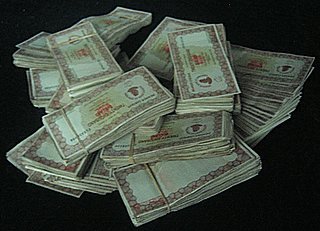
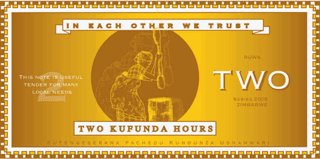
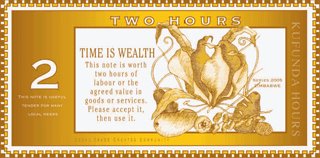
One of the gestures being made by the Kufunda Community in Zimbabwe is to print its own money. This is an obvious move in response to an inflation rate in that country that is running at over 700% (at the last report). This is a practical step in creating a means to organise exchange between people in the wider community, by using a measure that holds its value because it is tied to something real and something everyone can relate to.
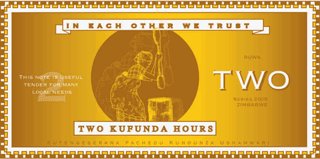
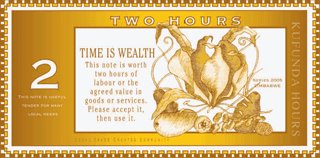
This weekend we are off to Taranaki to attend the New Zealand LETS conference, where I hope we will learn of the growing uptake of different examples of complimentary currencies across the country. I hope there will be lots to report on our return from this journey.
I have long felt that the existence of a stable means of measuring exchange are a foundation stone of any society. And I think complimentary currencies such as this will become invaluable when the impacts of our present political, social and environmental direction result in a significant breakdown of the present economic structures we have come to rely upon, and which we foolishly(?) assume will always exist, pretty much in their present form.
And if I am wrong about the likely demise, then there are other good reasons to seriously think about taking up such alternative systems. One of these is to reclaim control of the mechanism of exchange we consent to use. At present the exchange is controlled by a few greedy bankers, and the system advantages them very well but does not work so well for the good of the whole - the planet or its people. Our current economic model is a not insignificant factor in the manifestations we see around us - this is yesterday's future, what do we want tomorrow's future to look like?
 An inspiring story