This is yesterday's future... the moment we have been waiting for and co-creating with our imagination, thoughts, words, deeds, fears, hopes, desires - and our silence.
Did I tell you that this year is my year for focusing on food? Specifically local food production in all its wonderful and diverse forms.
I see us using the great breadth and depth of wisdom and knowledge we have, so we can begin to enjoy an abundance of healthy and vibrant, locally grown food fit to nourish our souls. I see a generosity of spirit as one after another land owner or land care-taker, offers access to the earth for the purposes of growing food. I see us building the soil - a sure sign of a civilisation that believes there is a future and respects the life giving earth which will nourish future generations. I see a community of healthy happy people with full stomachs, and not one person left out. I see men, women and children coming together to engage each other in conversation about real things and I see us feeling good about ourselves, as we contribute to the good of the whole.
After watching the wonderful film about Peter Proctor's work in India, I thought a little research was in order. I entered "Biodynamics" in google video and the one which caught my eye was a one minute piece that shows a tomato plant, the like of which I have never seen. I was curious what he put in that hole, so I went to [www.rotheraine.com] the link given in the description and found this 10 minute presentation that describes some of the key components of a recipe that has given others the same result.
Here is the 34 minute video compilation that Derek and I put together with the help of a dear friend and video editor.
It is a collection of short clips from six current documentary films describing some of the challenges that face us as a species. They are organised under the headings of Peak Oil, Economic Collapse, Climate Change and Responses to these. Here is a list of the films and a description of the specific short clips which are included in this 34 minute compilation:
The Power of Community - A succinct history of Peak Oil and how Cuba came to their own Peak Oil moment with the collapse of the Soviet Union in the late 1980's. It shows a little glimpse of the grass roots response to the need to feed their population, when their oil-dependent agriculture was no longer able to do so.
Oil Smoke and Mirrors - Richard Heinburg, author of The Party's Over: Oil, War and the Fate of Industrial Societies, and the book Powerdown: Options and Action for a Post-Carbon World, expresses how easy it is, even for him, to fall into a level of denial about the significant changes that are almost certainly headed our way. A few other highly reputable politicians, business people and a geologist speak about dependence on Oil, the potential for global economic upheaval, and an explanation of why the media is largely quiet on these subjects.
David Attenborough's BBC documentary, Can We Save Planet Earth - CO2 is made visible in a clever graphic display and explanation of its sources and effects. We hear about China's direction and their part in the growing total of CO2 that is being released into our atmosphere.
Denial Stops Here - Michael Ruppert offers his insights into the global economic environment and makes some startling suggestions about the implications of the current situation.
An Inconvenient Truth - It is hard to go past Al Gore's big CO2 and Global temperature chart for the last 650,000 years, without asking what might be in store for us.
The End of Suburbia - despite this being the oldest film in the line-up, with footage taken from the Paris meeting of ASPO (Association for the Study of Peak Oil) in 2002, it's contribution is valuable. This puts recent world events into perspective, and helps explain some of the lead up to them.
We hope this compilation (in all its amateur and jerky wonder) captures the essence of key issues which are already facing us as we race towards a global population of 7 billion persons. A key message is that each of us needs to learn how to reduce our footprint on this earth, and find ways, through cooperation and mutual support to meet our needs without disadvantaging future generations. There is nothing refined about this production, but it is our humble effort to share information with you. Now if you know of anyone who wants to throw some money at this project, and have it made into a cleaner presentation, we are more than happy to help. But this was the result of some concerned citizens who squeezed in a few late nights in their busy schedule to put this together with limited technology.
Thanks Michael for inviting me over to watch this video with you. Wow!
Peter Proctor is the lie to the belief that "I" can't do much to change things for the better. I would love one day to know that I had done one tenth of what this man has done to benefit the human community.
If you are lucky enough to live on Waiheke Island, but you can't wait, then order the DVD directly and support our kiwi producers - well done guys, this is fabulous footage, edited expertly. For the rest of you, if you are beginning to wonder how you might eat when the oil gets too expensive and scarce for driving farm machinery, then order one today.
She recently sent me some Leek seeds, with a note to "Sow leeks now, for good sized crop in winter. Love, Helen" I got them in some seedling pots on New Years eve. Thank you Helen for this lovely gesture of support, you are an inspiration.
Here are the pots with Helen's leek seeds in - protected from the birds and the drying effect of the sun. I aded some dry worm castings, harvested a year ago, to the potting mix. I only planted half the seeds, as I recall that the period following the full moon is said to be better for root crops. People rarely write or talk about their gardens until they have perfected some aspect of them. It is easy to feel daunted by all the volumes of books and articles on the subject. Where do we start! My friend Scott has often expressed the basic truth that "you don't need to know all the answers before you begin."
A Growing Opportunity Urban agriculture takes root in empty lots and abandoned spaces Don Butler The Ottawa CitizenSunday, June 18, 2006
Argentina's 2001 meltdown hit the city of Rosario hard. Fully 800,000 of its 1.2 million residents were plunged into poverty because of widespread unemployment caused by the economic crash.
To cope, the city, located about 300 kilometres northwest of Buenos Aires, turned to a seemingly quixotic strategy -- urban agriculture.
It turned over public land, offered tax breaks to owners of vacant lots who agreed to let poor residents grow organic produce on their property, and began to supply tools, seeds and other supplies.
Before long, more than 800 community gardens had sprung up, supporting 10,000 farmers and their families. What they didn't need for themselves, they could sell in one of seven new farmer's markets established by the city. Read on...
Thanks to everyone for continued support to the community garden and the food exchange stall.
Roberta and Millicent attended the food exchange stall last weekend and had a stead flow of produce being exchanged as well as a healthy volume of interest in the concept of sharing in our abundance. This week Robin is back on the stall, which will continue to be setup inside the hall for these winter months - though it will be nice to be back outside when the warmer weather returns.
Several keen volunteers who have been moving a large stack of donated bricks from a house in Kennedy Point to the community garden over the last couple of weeks.
Why bricks? Initially we thought it would be fun to create some bordered areas - such as a spiral herb garden. Then I got in contact with Grant Steven, who refers to himself as a biological gardener working with intensive gardening systems on a large scale in the Bay of Islands. Grant has developed a system for raised bed gardens which is proving very effective, and has offered to use his moulds and help us to set up some raised beds in the community garden - which is where the bricks can be helpful.
You can meet Grant at the Waiheke Community Cinema on July 4th (7:30pm) when we are screening The End of Suburbia, a film that is a very clear introduction to Peak Oil. Grant is actively involved in helping to communicate about Peak Oil (he is well versed on this subject) and helping people to see that we need to be localising - growing our food much closer to home. The years of the 3,000 mile Ceaser Salad are coming to an end.
It feels good to use this garden as an example of different growing methods, and having some intensive raised bed gardens here, next to the market, will be an opportunity for more people to learn different methods of intensive food growing on any small piece of sunny ground they may have access to.
Dave from Waiheke Couriers, who owns the land we are growing on, continues to be incredibly supportive of our work in the garden and is happy for us to develop these raised intensive beds, and such like. On behalf of all of us, many thanks to you Dave, your generosity does not go unnoticed.
"Maybe the enemy is us... Grow food at home." - Matthew R. Simmons, June 20, 2004, at the Pentagon-sponsored seminar series Energy: A Conversation About Our National Addiction
It does not take long for people who study peak oil to see some heavy implications of the end of abundant oil. After a while some of the more realistic probabilities become clear and often become one's main topic of conversation.
The possibilities, dangers and opportunities start motivating one to change his or her life.But it takes more than the few years that most students of peak oil today have under their belts for the stark picture to come into clear focus. It helps if one has grounding in the petroleum industry, but it's all too rare; people in extractive industries seldom seem to show they care for the greater welfare of the world. And those who don't want to believe there is now - or soon will be - an historic crisis regarding the peaking of world oil extraction are often 100% wedded to the status quo. It is left, then, for many a non petroleum professional to hold forth and help lead us...
...Matt Simmons is a man who has reflected on the waste of energy that ordinarily would be delightful for any businessman in energy. But he wryly complains of "blueberries in Maine imported from Chile even during blueberry season." Likewise for the nation’s infrastructure: "You can tear up the roads," he said, to stop the wasteful trucking and start barging on water, to save 35 times as much energy. He mentions rail also as a major replacement for our highways, as freight by rail saves 8 times the energy. He would know, however, that today’s volume of trade cannot fit on existing railcars and barges, and that there’s little likelihood that the nation’s infrastructure can change quickly enough for the peak oil timetable...
...And when is peak? "Realistically, we’re probably at peak now. If not, production will fall faster later" as a result of rising demand. This definitive conclusion is from a data specialist on the main assets of the petroleum industry: reserves and the whole industry’s ability to extract, refine and distribute at a profit. He is not surprised that peak is here, nor that we are caught unprepared. He offers his audiences instances of the public and leaders ignoring past warnings, such as M. King Hubbert’s on the peaking of domestic and global oil extraction...
...Given what Simmons knows, and speaking to a largely Pentagon audience sprinkled with Republicans from Capitol Hill, it was surprising to hear him confidently inform us that "A call to arms may be wrong. We may not even know who the enemy is. And maybe the enemy is us." In Simmons’ PowerPoint presentation he refers to "phony wars."...
Unfortunately it may take catastrophic change before people ask themselves the most important question of the 21st Century: "“How are we going to eat" Michael Kane, a writer From The Wilderness
Does this look to you, like something that will continue into the coming decades?
This year's world grain harvest is projected to fall short of consumption by 61 million tons, marking the sixth time in the last seven years that production has failed to satisfy demand. As a result of these shortfalls, world carryover stocks at the end of this crop year are projected to drop to 57 days of consumption, the shortest buffer since the 56-day-low in 1972 that triggered a doubling of grain prices.
World grain consumption has risen in each of the last 45 years except for three—1974, 1988, and 1995—when tight supplies and sharp price hikes lowered consumption (See Figure). Growth in world grain demand, traditionally driven by population growth and rising incomes, is also now being driven by the fast growing demand for grain-based fuel ethanol for cars.
Roughly 60 percent of the world grain harvest is consumed as food, 36 percent as feed, and 3 percent as fuel. While the use of grain for food and feed grows by roughly 1 percent per year, that used for fuel is growing by over 20 percent per year.
Grain is one of the basic calorie crops which make up a large part of the Western diet. We have become used to shelves stocked with long distance foods. While we can relatively easily grow a few veges, learning to grow our food, in particular the larger volume of calorie crops will be the challenge in a low energy future. We will need to devote larger areas of land to organic production - this will mean more effort and labour especially in the early phase as we regenerate the soil which has been made effectively dead through the use of fossil-fuel chemicals, pesticides and fertilisers.
The Whole Human Being: a "new" and savvy citizen for our times Written by Jan Lundberg Culture Change Letter #133 - June 20, 2006
In this time of mounting threat to our species and the entire biosphere, our weakness seems to come down to individualism and materialism.
. . . Our idea of what is necessary to survive has broadened materially and technologically. So not only is happiness no longer achieved by pursuing selfishness as individuals and materialists, our very survival is in question if we keep going with today’s extreme forms of individualism and materialism.
. . . Meanwhile, amassing knowledge of sustainable living is only prudent in a time of overspecialization and high vulnerability to complex systems and unaccountable, distant authorities. Although consumers may be too dense and lazy today to change proactively to deal with the fact that local food production is wise when the average piece of food travels 1,500 miles, we may have to write off these unfortunate folks for the moment as we go about preparing our own closer relationship with nature. We are too fragile and out of touch, much like those in a 1960s song who have "arms that can only lift a spoon." We must also work on our relationships with each other:
The reforming of tribes has been going on right under consumer society’s nose since the 1960s; a few aware people are biding their time. So, we must continue trying to come together as neighbors, families, band members, comrades, and communitarians. The answers are not waiting for us on the desks of government officials, nor in corporate advertising campaigns or news programs.
Every decade the modern man is appreciably weaker. He is more dependent on technology and has less wild nature around him. He is less likely to use basic, traditional skills to accomplish something for himself. Instead, he can buy it. He has less family around to participate in an activity, as other family members can be elsewhere being good consumers, students, workers or soldiers. He is more likely to be alone and is surrounded by plastic claptrap. What he thinks he needs to know is less likely to be found in his head or in others’ heads such as his elders’; he gets it from a computer...
It goes on and I cut out a lot, but I gotto get out of this computer and go and grow some veges!!
A friend wrote last night expressing his, understandable frustration about the slowness of the political leaders to respond to the facts of Peak Oil,and their failure to begin paving the way for new means of providing for the necessities of life. It grew out of a conversation around some documentary films on Cuba (The Power of Community, and The Greening of Cuba), who had their Peak Oil moment back in 1989.
The films tell how the average Cuban lost several pounds of body fat before their food growing efforts yielded fruit, but they came through and met the challenge in creative and innovative ways. They moved away from fossil fuel dependent agriculture and turned to permaculture and organics. There is much we can learn from them. One of these films is being screened at the Waiheke Community CInema on July 18th.
This is my letter in response to my friend's outpouring of frustration:
The Greens, Labour, ACT, National, and any others that may come along are part of an old system that I have been saying for some time is broken and is not supposed to be fixed. It is based on old models of working which don't (work) anymore. They assume a top down management model that wont work.
I dont waste my energy supporting or fighting them, but prefer to channel it into creating the bottom up foundational systems which will grow and thrive as the old systems collapse. As people wake up and see the extent to which they have been lied to by their leaders, they tend to express anger first, but then they look for other ways to function, operate, interact, live and get their needs met.
I dont believe that pointing fingers at Bush, or Cheney, Clark or any other 'leader' does anything more than postpone the inevitable moment when we wake up and realise that we are the responsible party. Looking to someone in a 'leadership' position and demanding they fix things is a form of giving away power. Me weak, you strong, you big powerful person fix this problem for poor powerless me.
The entire system that is consuming the final supplies of oil is being encouraged by those people, yes to be sure. But it is we the people who are filling our tanks, buying the produce which has travelled around the globe to get to our table, after being fertilised and pesticided and packaged to get there. As we wake up and do things differently we buy out of that system and withdraw our suppport for it.
Now it could move faster if 'leaders' got on board and helped educate the masses, who are asleep, because they continue to be fed world cup football and told that everything is fine - just keep consuming. But then those people would remain in the same position of being manipulated by whatever the latest message is. And this moment seems to be about awakening from the slumber and becoming self-aware and aware of our inter-dependent place in the totality of humanity.
My reading of the situation is that there will be a significant die-off of the human population. We have found a food/energy source that has enabled us to explode our population - it has doubled in my lifetime. Now that food/energy source has peaked and we are on the downward slide, and with it will surely come a reduction in the population that depends on it.
Some realise this, and are stepping back from dependence on oil as an energy/food source, and I would rather put my time into supporting and working with those people, than struggle to wake up those who are fast asleep.
It turns out that having asked for permission from their US captives to have a food garden and having been refused, a group of prisoners have made their own garden, within the camp.
The Power of Community On the Transition Culture blog was an announcement about a new and uplifting film: The Power of Community, which explores what happened to Cuba when their oil supply disappeared, almost overnight, with the collapse of the Soviet Union in 1989. Read more about The Power of Community here:
Fuelling the Future Last year there was a two day conference held in Kinsale (County Cork, Ireland) who produced the Energy Descent Plan.
The conference addressed not only the issue of peak oil but also a range of solutions to it, from natural building and local food production to renewable energy and local economics. The weekend was a huge success and has done much to promote discussion around the issue of peak oil in Ireland.
Speakers included Richard Heinberg, Colin Campbell, David Holmgren and Richard Douthwaite. Fuelling the Future has just released a 2-disc DVD set of the conference featuring all the main speakers. Read more about Fuelling the Future here:
Joel believes that the only meaningful guarantee of integrity is when buyers and sellers can look one another in the eye...
”Joel, who describes himself as a “Christian-libertarian-environmentalist-lunatic farmer,” speaks of his farming as his “ministry,” and certainly his 1,000 or so regular customers hear plenty of preaching. Each spring he sends out a long, feisty, single-spaced letter that could convince even a fast-food junkie that buying a pastured broiler from Polyface Farm qualifies as an act of social, environmental, nutritional, and political redemption.
“Greetings from the non-bar code people,” began one recent missive, before launching into a high-flying jeremiad against our disconnected “multi-national global corporate techno-glitzy food system” with its “industrial fecal factory concentration camp farms.” (The dangerous pileup of modifiers is a hallmark of Joel’s rhetorical style.)
Like any good jeremiad, this one eventually transits from despair to hope, noting that the “yearning in the human soul to smell a flower, pet a pig and enjoy food with a face is stronger now than anytime in history,” before moving into a matter-of-fact discussion of this year’s prices and the paramount importance of sending in your order blanks and showing up to collect your chickens on time. For the whole story
It was a beautiful sunny day yesterday, and I spent most of it turning soil into new garden beds. I used the double dig method described by John Jeavons, then sowed them with Mustard seed, and a row of Pea and Broad Bean seedlings.
I thought I had done enough, but when I went down to the beach for a cool refreshing swim I discovered 5 dead Penguins (probably the result of the storm on the weekend), and had to dig over another patch, which became the Penguin bed.
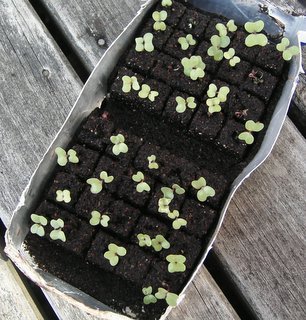
Today I transfered some of the Lettuce, Brocolli and Red Cabbage seedlings from the soil cubes, into pots. Very satisfying.
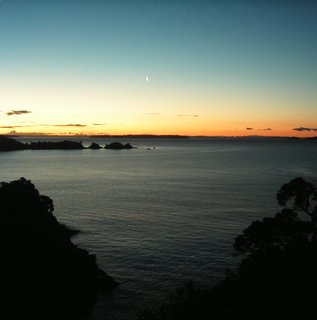
What a gift to be able to live in such a place that puts on displays like this at the end of a day.
HOW TO BE AN ENVIRONMENTALIST: GOTTA GIT A GREEN THUMB
If you don't have one already, there's no better time than the present to start your own vegetable garden, whether it's on your own land or in a local community plot.
According to the latest data from the US Department of Agriculture, the level of home food production is at its lowest point in US history. With the average food traveling more than 1500 miles from farm to fork, the environmental impact of big agribusiness foods is at an all time high.
To back this up, John Jeavons suggests that in the US only one person in 500 is a farmer producing food. What are the consequences of this? When so few people know how to grow food, and then only doing so supported by the phenomenal usage of fossil fuels?
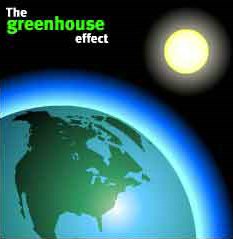
Concerned about global warming and peak oil? Consider the fact that it takes 400 calories of fossil fuels to transport a single 5 calorie strawberry from California to East Coast supermarkets. What's more, that flavorless non-organic strawberry was grown with methyl bromide, a carcinogenic and ozone depleting pesticide.
In contrast, a perennial patch of strawberries in your yard grows back on its own every year, requires no fossil fuels and no pesticides, and tastes a whole lot better. The environmental benefits of growing some of your own food are staggering. The Organic Consumers Association is developing a new campaign to help turn every thumb into a Green thumb.
"Peak Oil will occur when half of all the oil has been pulled from the ground. After that, oil will become increasingly scarce, and increasingly expensive, over time. When oil becomes expensive the economy goes into recession until it becomes cheap again. Peak Oil means that oil will only get more expensive, forever.
Many people who know what they're talking about think we are at Peak right now."
This succinct description of peak oil and the consequences came from this Adaptation site which also runs a blog, that looks very interesting and practical.
I got onto the Adaption blog via this morning's post on Dave's How to Save the World blog, in which he describes very well, some different views on what will happen in society when the biggest economy in the world eventually declines into the next great depression.
My response to sensing this has been to learn to grow food and help other people do likewise. If you don't have food security, then neither do I. And from what I am reading now, it seems that with logical changes in diet and bio intensive gardening we can grow enough for all of us and in a time frame that will allow us plenty of opportunity to do other things. This is not a descent into some cold dark cave man scenario where we spend all our time "struggling to survive" - it is a sideways step to participation in, and deeper appreciation of, our proper place in the natural world.
Without it we don't eat. OK we don't eat soil, but make the leap if you will and consider where our food comes from. My dearly beloved partner, Kim, has often confessed that as a child she assumed food came from the shelves of a supermarket. Astounding but true, and true, no doubt, for a lot more people in so called developed nations.
How is it that we people's of the nations who claim the title of developed, have developed ourselves so far from reality? Food comes from the soil. Without soil we will go hungry. And we are effectivley flushing it down the e are losing it at a phenomenal rate.
It has been recently estimated that there is as little as a 50-year supply of topsoil remaining globally.
Yet, we all can be a part of the solution. While U.S. agricultural practices deplete the soil 18 to 80 times more rapidly than it is built up in nature, sustainable "GROW BIOINTENSIVE" mini-farming, when used properly, has the capacity to build the soil up to 60 times faster than in nature, while producing high yields with a fraction of the resources normally required. This diagram shows the amount of soil that is "consumed" to produce the food we eat, in the US, Developing Nations, China, and lastely it shows the soil that is built up using this grow biointensive method. (click on the graphic to see a larger readable version).
GROW BIOINTENSIVE Mini - Farming This miniaturization of agriculture is not new. Small-scale, sustainable agriculture has supported such widely dispersed civilizations as the Chinese 4,000 years ago, and the Mayans, South Americans, and Greeks 2,000 years ago.
Ecology Action has dedicated almost a quarter-century to rediscovering the scientific principles that underlie these traditional systems. The people in Biosphere II in Arizona have been using techniques based on those outlined by Ecology Action: they raised 80 percent of their food for two years within a "closed system."
Their experience demonstrates that a complete year's diet for one person can be raised on the equivalent of 3,403 square feet!This is an improvement over traditional Chinese practices, which required 5,000 to 7,200 square feet. In contrast, it takes commercial agriculture 22,000 to 42,000 square feet to grow all the food for one person for one year, while bringing in large inputs from other areas.
At the same time, commercial agricultural practices are causing the loss of approximately six pounds of soil for each pound of food produced.GROW BIOINTENSIVE mini-farming techniques make it possible to grow food using 99 percent less energy in all forms - human and mechanical, 66 percent to 88 percent less water, and 50 percent to 100 percent less fertilizer, compared to commercial agriculture.
They also produce two to six times more food and build the soil.
In a conversation last Saturday night, a friend talked about the concept of changing our lives in order to live within our means. Is it me, am I attracting people thinking this way, or is there a owowing awareness of these issues because they are becoming critical to our future well-being and even survival?
This is a concept that is relatively new and I am going to hand over to David Holmgren, co-founder of the Permaculture concepts, to speak to it more eloquently than I could...
While permaculture strategies mesh nicely with many of those directed towards this generally accepted desirable future, permaculture in fact defines a creative response to a fourth scenario that I call “Earth Stewardship” - a “creative descent” in which we progressively reduce our energy demands to return eventually to living within the natural energy and production budget of the land we occupy. Elements of all these scenarios can be found in the wide-ranging viewpoints and arguments of today’s “sustainability” debates.
In the Earth Stewardship “creative descent” scenario, which I consider to represent the only truly sustainable future, human society creatively descends the energy demand slope essentially as a ‘mirror image’ of the creative energy ascent that occurred between the onset of the industrial revolution and the present day. The actual sustainable plateau is a long way down from current energy demands, but also a long way ahead in time. If we begin our journey now, there is time to use our familiarity with continuous change and creative innovation to avoid bringing on “Atlantis”.
So, in an energy-descent future, what are the prospects close to home - here where we live in suburbia? Will it be the end of suburbia? What if we can no longer afford to commute to work by car? What if we are dependent on food and energy supplies that are transported long distances at increasing expense? What if the services and functionality of our communities decline further so that there is ever-diminishing support from local councils and police, for example?
There is a real and viable alternative to this seemingly alarming scenario - a retrofit of suburbia - a remodelling of local neighbourhoods and communities for the energy-descent future. The “refit manual” will bring together and integrate features such as:
Home-based work, telecommuting, and cottage industries serving a local clientele;
Extended families, lodgers and shared households;
Recycling of storm water, waste water, and human waste;
Soils of improved fertility, and the water supply and infrastructure for urban agriculture;
City farms, cooperative gardening, Farmers’ Markets, and Community Supported Agriculture schemes (CSAs)
Community Supported Agriculture (CSA) is a scheme in which customers undertake to buy a regular box of in-season fruits, vegetables, eggs, etc. from one or more local producers, thus providing the latter with a secure income and the ability to diversify the types of produce they provide.
The bottom line here is that we do not need to wait for policies to change. We can choose today to do this - to create our own small neighbourhoods. ‘Suburban sprawl’ in fact give us an advantage. Detached houses are easy to retrofit, and the space around them allows for solar access and space for food production. A water supply is already in place, our pampered, unproductive ornamental gardens have fertile soils and ready access to nutrients, and we live in ideal areas with mild climates, access to the sea, the city and inland country.
Involve the kids - and their friends. Make contact with neighbours and start to barter. Review your material needs and reduce consumption. Share your home - by bringing a family member back or taking in a lodger, for example. Creatively and positively work around regulatory impediments, aiming to help change them in the longer term. Pay off your debts. Work from home. And above all, retrofit your home for your own sustainable future, not for speculative monetary gain.
In an energy-descent world, self-reliance represents real opportunities for early adopters of a permaculture life style:
Rises in oil prices will flow through to all natural products (food, timber, etc);
Higher commodity prices will be a stimulus for self-reliance and organic farming;
Local products will be more competitive than imports;
Repair, retrofitting, and recycling will all be more competitive than new replacement;
There will be rising demand for permaculture as life-skills eduction; and
There will be a resurgence of community life, ethics and values.
There are, however, some real hazards for the greater community in the energy-descent scenario. For example, perverse subsidies and “head-in-the-sand” policies could distort necessary market adjustments (e.g., the end of fuel tax combined with production subsidies to agribusiness). There is a real danger that fascist-style politics could see minorities and those providing for themselves as being to blame for declining social conditions.
Sudden economic and environmental shocks could conceivably lead to social collapse, removing even the security necessary for local food production. We need to understand the energy-descent pathway ahead, act to ensure our own longer-term resource security, and keep ourselves informed about the viewpoints and approaches of the greater national and global communities around us.
Kim and I hosted an event at the local cinema last night to speak about our trip to Zimbabwe, and to share in an experiential way, the dialogue process of Calling the Circle. Judging by people's expression in the circle, and the gratitude expressed at the end of the night, it was well received. It seems that people are hungry to be heard, and to be in a safe place where those things that are most important, relevant and urgent in their thoughts and feelings, can be expressed.
We are living though a time that is pregnant with possibility. I have spent 3 years supporting the New Zealand Transition Towns relocalisation movement, and welcome opportunities for dialogue, with serious people, about what is possible for us to do right now.


 Thanks Michael for inviting me over to watch this video with you. Wow!

 A Growing Opportunity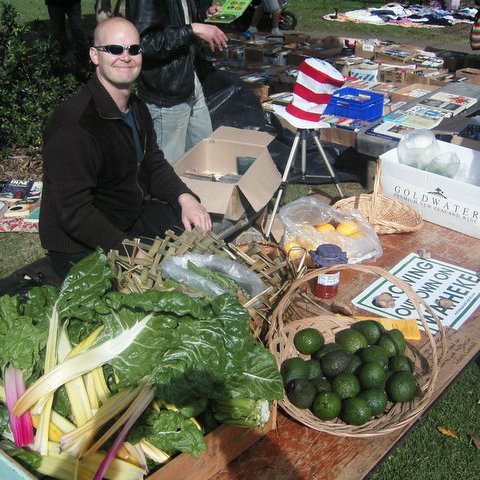
 The maturation of Matt Simmons, energy-industry investment banker and peak oil guru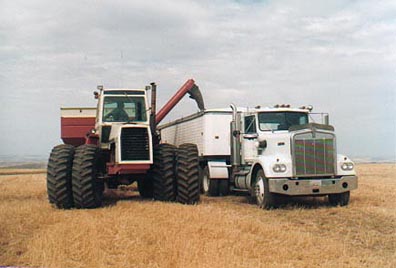
 A friend wrote last night expressing his, understandable frustration about the slowness of the political leaders to respond to the facts of Peak Oil,and their failure to begin paving the way for new means of providing for the necessities of life. It grew out of a conversation around some documentary films on Cuba (The Power of Community, and The Greening of Cuba), who had their Peak Oil moment back in 1989.
 Joel believes that the only meaningful guarantee of integrity is when buyers and sellers can look one another in the eye...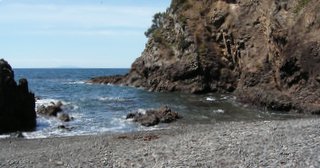
 HOW TO BE AN ENVIRONMENTALIST: GOTTA GIT A GREEN THUMB
 "Peak Oil will occur when half of all the oil has been pulled from the ground. After that, oil will become increasingly scarce, and increasingly expensive, over time. When oil becomes expensive the economy goes into recession until it becomes cheap again. Peak Oil means that oil will only get more expensive, forever.
 Sydney Peak Oil This is a fantastic resource for those of us who can watch video on-line.
 In a conversation last Saturday night, a friend talked about the concept of changing our lives in order to live within our means. Is it me, am I attracting people thinking this way, or is there a owowing awareness of these issues because they are becoming critical to our future well-being and even survival?