Saturday, April 29

soil and oil

Sydney Peak Oil This is a fantastic resource for those of us who can watch video on-line.

And on this site you can find the following one hour plus video/audio on the subject of soil and oil by the founder of the
GROW BIOINTENSIVE Mini - Farming mentioned in the previous post on soil. I listened to it this morning, while the rain, lightning and thunder performed their dance outside my window.

Friday, April 28

soil

Without it we don't eat. OK we don't eat soil, but make the leap if you will and consider where our food comes from. My dearly beloved partner, Kim, has often confessed that as a child she assumed food came from the shelves of a supermarket. Astounding but true, and true, no doubt, for a lot more people in so called developed nations.

How is it that we people's of the nations who claim the title of developed, have developed ourselves so far from reality? Food comes from the soil. Without soil we will go hungry. And we are effectivley flushing it down the e are losing it at a phenomenal rate.

It has been recently estimated that there is as little as a 50-year supply of topsoil remaining globally.
Yet, we all can be a part of the solution. While U.S. agricultural practices deplete the soil 18 to 80 times more rapidly than it is built up in nature, sustainable "GROW BIOINTENSIVE" mini-farming, when used properly, has the capacity to build the soil up to 60 times faster than in nature, while producing high yields with a fraction of the resources normally required. This diagram shows the amount of soil that is "consumed" to produce the food we eat, in the US, Developing Nations, China, and lastely it shows the soil that is built up using this grow biointensive method. (click on the graphic to see a larger readable version).


GROW BIOINTENSIVE Mini - Farming
This miniaturization of agriculture is not new. Small-scale, sustainable agriculture has supported such widely dispersed civilizations as the Chinese 4,000 years ago, and the Mayans, South Americans, and Greeks 2,000 years ago.

Ecology Action has dedicated almost a quarter-century to rediscovering the scientific principles that underlie these traditional systems. The people in Biosphere II in Arizona have been using techniques based on those outlined by Ecology Action: they raised 80 percent of their food for two years within a "closed system."

Their experience demonstrates that a complete year's diet for one person can be raised on the equivalent of 3,403 square feet!
This is an improvement over traditional Chinese practices, which required 5,000 to 7,200 square feet. In contrast, it takes commercial agriculture 22,000 to 42,000 square feet to grow all the food for one person for one year, while bringing in large inputs from other areas.

At the same time, commercial agricultural practices are causing the loss of approximately six pounds of soil for each pound of food produced.
GROW BIOINTENSIVE mini-farming techniques make it possible to grow food using 99 percent less energy in all forms - human and mechanical, 66 percent to 88 percent less water, and 50 percent to 100 percent less fertilizer, compared to commercial agriculture.

They also produce two to six times more food and build the soil.

good morning


What a way to wake up!

Thursday, April 27

the earth charter initiative

I read the Earth Charter today.

A document which was created over a period of 10 years, and a magnificent declaration of values. It is concise and thorough, and if it was taken up "as a common standard by which the conduct of all individuals, organizations, businesses, governments, and transnational institutions is to be guided and assessed" we might all be better able to meet the challenges ahead.

From the Preamble:

THE GLOBAL SITUATION: The dominant patterns of production and consumption are causing environmental devastation, the depletion of resources, and a massive extinction of species. Communities are being undermined. The benefits of development are not shared equitably and the gap between rich and poor is widening. Injustice, poverty, ignorance, and violent conflict are widespread and the cause of great suffering. An unprecedented rise in human population has overburdened ecological and social systems. The foundations of global security are threatened. These trends are perilous—but not inevitable.

car sharing


How it works?
The UK example: Customers sign up and pay a one-off lifetime membership fee of GBP 25. Booking takes place online or by phone, and a confirmation with the car's details (exact location, colour, license plate number) is sent to the customer both by email and sms. An sms is also sent to the car, to tell it who will pick it up.

To unlock a car, customers hold a smart card up to the windshield. Door opens, and they'll find the ignition key in the glove compartment. Monthly bills give a detailed breakdown of all journeys, and show how much was saved by not owning a car. The entire process is extremely customer-friendly, and nice touches include an iPod connector in every car, as well as a hands-free car phone that users can forward their own mobile phone to.

  • ...fragmented car ownership is a highly promising business concept: increasing numbers of consumers are more interested in experience than ownership, no longer viewing cars as the ultimate status-symbol, but as a utility. Serving them and being green doesn't mean forsaking profits: Streetcar went into the black 18 months after launching. And every car shared results in 6 private cars being taken off the road. May sharing proliferate!
Thanks Laurence for the lead to this solution

Wednesday, April 26

so much happening

It's hard to stay off the computer some days. There seems to be so much happening in the world.

Then again I was never afraid I would miss anything of importance in the days before the internet when I almost never read a newspaper, listened to the radio, or watched television for 15 years. As part of a religious-spiritual community there was always plenty to keep us occupied, and the important things always got through.


But there's a balance, and I am happy to have had the time over the last two years to delve deeply into the workings of the world, through the eyes of those who seem to speak my language, and see things from a larger, more human, caring, and self-transcending vantage point.

--- 0 ---

I did manage to plant some more seeds today. Red Cabbage, Broccoli, and even some White Strawberry. It gives me great pleasure to see the pots bursting with life. We will need to find some gardens to put them in soon.

Tuesday, April 25

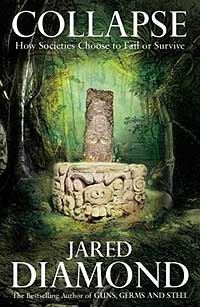
collapse

Collapse was often associated with failing to agree on exercising restraint in harvesting a shared resource.

More info on this important book.

--- 0 ---

I made a bench this morning for my abundant vegetable seedlings, which are growing strong.

Monday, April 24

energy descent plan


The Kinsale Energy Descent Energy Action Plan – an introduction.
by Rob Hopkins, course co-ordinator, Kinsale FEC


Oil
Oil is an amazing material. It can power aeroplanes, run cars and lorries, heat our homes and generate electricity. It can be turned into a huge array of plastics and other polymers the world has never seen before, allowing us access to a great diversity of products our ancestors could only have dreamt of – what Kinsale’s ancient mariners would have given to get their hands on fibreglass and silicon mastic! It can be manufactured into medicines; the vast majority of modern drugs are petrochemical-based. Oil is used to power the production of high embodied energy materials such as cement, aluminium, steel and glass, which we use to house ourselves.

It has facilitated a huge growth in employment and economic wealth, created prosperity previous generations could only have dreamt of. It has allowed us to build an economy where we manufacture less and less and import more and more. We export butter and we import butter. We remove our native orchards and buy apples from the cheapest seller wherever that may be around the world. We have created a façade of wealth while at the same time wantonly discarding the very things that at any other time in history constituted real wealth - well managed diverse woodlands, local, vibrant, diverse food markets, local skills and traditions, local genetic diversity, breeds and varieties uniquely suited to local climate and soils.

However, while oil has brought undeniable benefits, these have come with a price tag. The dangers posed to us all by global warming are known to all at this stage, but suffice to say we have altered the climate in ways that are already causing chaos around the world, and it is only just the beginning.

We live in a world where oil has allowed us to create a huge range of chemical compounds never seen in the world before, many of which have been linked to problems in human health and environmental pollution. It is estimated that we all carry about 400-500 chemicals in our bodies that did not exist sixty years ago. It has also allowed us to create a lifestyle where we live faster - we drive to shop, drive to work, drive to be entertained. We are more stressed and unsatisfied, we sit down to meals with our families less and less, we have less and less time to relax with friends, there is a growing sense that “something is missing”.

The Peak
As Dr. Colin Campbell’s article below sets out, we are reaching a pivotal point in human history. At that moment, global oil production will peak, and from then on, demand will always exceed supply. There will never again be as much oil available as there is now. In short, we will reach (or have already reached) the point at which growth will become impossible. Our economies will need to make the transition to continual contraction rather than relentless growth. There will still be oil in the ground, but its extraction will become unfeasibly expensive and impractical, and our economies, designed on the fundamental assumption that they will always be growing, will have a traumatic period of adjustment to the new reality.

The co-founder of permaculture, David Holmgren, likens our situation to being on the top of a mountain, from where we have views that no-one has ever seen before, but where the storm clouds are gathering. We have to navigate a way down the mountain while we still can, while we still have favourable weather and daylight. If we just allow the peak to happen, without planning for it, we will be in for a very rough ride.

Energy Descent
A planned way down
There is an old saying, “there are three kinds of people; one who watches things happen, one who makes things happen and one who says 'what happened ?'. We do have an alternative to just sitting back and allowing a deeply uncertain future to simply unfold. Our collective dependence on fossil fuels leaves us very vulnerable, and indeed is largely responsible for the instability we see in the world today. To quote Jan Lundberg of the Sustainable Energy Institute, “real peace in a petroleum-fuelled world means rejecting petroleum dependence in all ways possible”.

Sunday, April 23

global public media

I went searching today - for some blogs or sites with solutions and real news that can help serve the transition out of our oil based society. This was the gem I found.


If you go searching within this site you will find many pertinent interviews , both audio and video, which can be downloaded (and shared).

endless oil supplies?

At our Easter gathering last weekend, Danielle told me about a documentary, she had seen on TV, which discussed the 'new' oil reserves in Canada.

I understood that the documentary suggested these new fields along with new extraction technology, was going to help counter the suggested soon-to-be, or maybe already-present, shortfalls in oil production over consumption.

I thought I should do some research, since I had only limited information to offer.

A no-apologies introduction to this subject
For all the people touting tar sands as a solution to the pending apocalypse of Peak Oil, a little experience with reality [could] help them understand that the books on energy are as cooked as the books of Enron, WorldCom and Halliburton. When business tells you there's plenty of oil it is [worth asking whether this might be] to protect the financial markets. Source

From the Sierra Club

"Tar sands oil is to conventional oil what crack cocaine is to ordinary cocaine powder. More harm to global climate through increased greenhouse gas emissions, more destruction of boreal forests, more toxic tailings and more air and water pollution." said Elizabeth May, executive director of Sierra Club of Canada. Source


Alberta's tar sands could hold more than 300 billion recoverable barrels of oil. The term "tar sands" refers to a thick oil called bitumen that is mixed in with sand, clay and water. Unfortunately tar sands oil generates two-and-a-half times as much greenhouse gases of conventional oil production due to the massive amounts of energy needed to extract, upgrade and refine the bitumen.


Originally dug out of open pit mines, there is but companies are now moving away from these huge pits; a new technique allows them to inject steam directly into the soil to melt the tar enough so that it can be pumped back to the surface.

To generate the steam, they burn natural gas, and this is one of the main reasons why Canada has so much trouble meeting its obligations under the Kyoto treaty, and why this source of oil generates between two and three times the greenhouse gases to obtain. Source

Probably the best source of information on the subject of global energy is EnergyBulletin.net. There is a wealth of information available under clear categories on the left hand menu. Start here

There are now a number of agreements that seem to have been reached across many areas of science and industry...
  1. Oil, coal and gas are non-renewable and limited resources.
  2. The burning of these contributes to greenhouse gases, and these are impacting on our environment.
  3. Peak oil is a fact What is harder to pinpoint and therefore where agreement is impossible to achieve, is whether peak oil has occurred already, or if it will happen at some future date.

This last point seems a little irrelevant given the established increasing difficulty and financial and environmental cost of obtaining oil from these 'new' sources. Oil will never be as cheap as it has been in the past. This is beginning to impact on our lives and will do so more with each increase in cost.


Being aware of these changes, it begs the question, how can we reduce our consumption - directly and indirectly - of oil and other non-renewable fuels?